Options Delta: Definition, Range and Worked Example
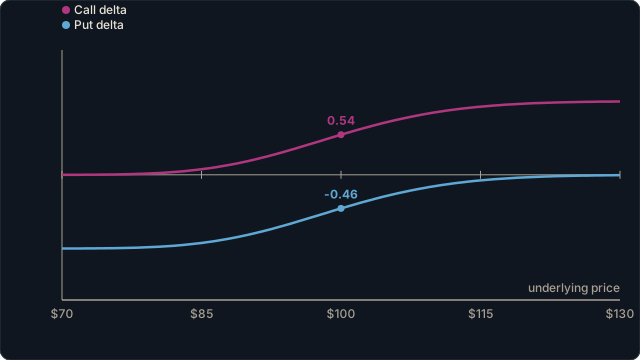
Delta is the rate of change of an option's price for every $1 move in the underlying asset; call options have positive delta (0 to 1) and put options have negative delta (−1 to 0). A call with a delta of 0.50 gains approximately $0.50 per share — $50 per standard contract — when the underlying rises $1.
What Delta Measures
Delta is the first-order sensitivity of an option's price to the underlying asset's price. It answers the practical question: if the stock moves $1, how much does my option move?
Delta is dimensionless — it is a ratio of price changes, not a dollar figure itself. To convert delta to dollars, multiply by the underlying price move and by 100 (the number of shares per standard equity options contract):
Example: a call with delta 0.40 changes by $40 per contract per $1 move in the underlying (0.40 × $1 × 100 = $40).
Delta Range by Option Type
| Option type | Delta range | Sign | Interpretation |
|---|---|---|---|
| Call (long) | 0 to +1 | Positive | Gains as underlying rises |
| Put (long) | −1 to 0 | Negative | Gains as underlying falls |
| Short call | −1 to 0 | Negative | Losses as underlying rises |
| Short put | 0 to +1 | Positive | Losses as underlying falls |
The sign of delta tells you which direction benefits the position. A short call has negative delta — the seller loses money as the underlying rises — which mirrors the sign convention for a long put.
How Delta Shifts with Moneyness
Delta is not constant; it changes as the underlying price moves relative to the strike. The relationship follows a predictable pattern:
| Moneyness | Call delta (approx.) | Put delta (approx.) | Interpretation |
|---|---|---|---|
| Deep in the money (ITM) | ≈ 1.00 | ≈ −1.00 | Behaves nearly like long or short stock |
| At the money (ATM) | ≈ 0.50 | ≈ −0.50 | Equal sensitivity in both directions |
| Out of the money (OTM) | ≈ 0.10–0.30 | ≈ −0.10 to −0.30 | Low sensitivity; mostly extrinsic value |
| Far out of the money | ≈ 0.01–0.05 | ≈ −0.01 to −0.05 | Minimal price sensitivity to underlying |
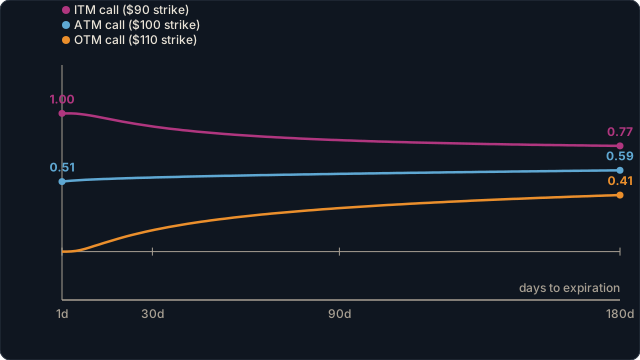
These are approximations. The exact delta at any moment depends on time to expiration, implied volatility, and the specific model used by a broker. The pattern — ITM → near 1, ATM ≈ 0.5, OTM → near 0 — is definitional and holds qualitatively across all standard pricing models.
Delta as Share Equivalence
Delta is also used as a share-equivalence measure, sometimes called the hedge ratio. A position with a total delta of 0.40 behaves, at this moment, as if you held 40 shares of the underlying for a one-contract position, or 4,000 shares for a 100-contract position.
This interpretation is useful for comparing options positions to stock positions and for calculating how many contracts of an option are needed to offset the delta exposure of a stock position. The hedge ratio interpretation is an approximation because delta itself changes as the underlying moves (see: Gamma).
Worked Example: Reading a Chain Row
All inputs are stated explicitly.
| Input | Value |
|---|---|
| Underlying (XYZ) | $100.00 |
| Option 1: Call strike | $100 (ATM) |
| Option 1: Delta | 0.50 |
| Option 2: Call strike | $110 (OTM by $10) |
| Option 2: Delta | 0.22 |
Dollar move if XYZ rises $1 (to $101):
- ATM call (delta 0.50): 0.50 × $1 × 100 = +$50 per contract
- OTM call (delta 0.22): 0.22 × $1 × 100 = +$22 per contract
Dollar move if XYZ falls $1 (to $99):
- ATM call (delta 0.50): 0.50 × (−$1) × 100 = −$50 per contract
- OTM call (delta 0.22): 0.22 × (−$1) × 100 = −$22 per contract
The OTM call is roughly half as sensitive to a $1 underlying move as the ATM call. That lower sensitivity comes with a lower premium — the OTM call costs less, and its limited delta reflects the lower probability that it ends up in the money.
Delta Changes Over Time
Delta is not static. As the underlying price moves, as time to expiration shrinks, and as implied volatility shifts, delta changes. The rate at which delta changes in response to a $1 move in the underlying is measured by the Greek called Gamma. Understanding gamma is essential for options holders who want to understand how their delta exposure evolves. See Gamma Explained for the companion concept.
Model delta in the options P&L calculator — enter any strike and premium, then move the underlying price to see the impact live.
Options Profit CalculatorRelated Concepts
- Gamma — rate of change of delta per $1 underlying move
- Vega — option sensitivity to implied volatility
- ITM vs OTM — definitions and intrinsic value for calls and puts
- Intrinsic vs Extrinsic Value — premium decomposition
More Strategy Guides
- Covered Call — long stock + short OTM call
- Cash-Secured Put — short put backed by full cash collateral
- Long Straddle — long ATM call + long ATM put; long gamma position
- Vertical Spread — all four verticals explained in one guide
Frequently Asked Questions
- What is delta in options trading?
- Delta is the rate of change of an option's price for every $1 move in the underlying asset. A call option with a delta of 0.50 gains approximately $0.50 in value when the underlying rises $1; a put option with a delta of -0.50 loses approximately $0.50 when the underlying rises $1. Delta is one of the primary options Greeks.
- What does a delta of 0.50 mean?
- A delta of 0.50 means the option's price is expected to change by $0.50 for each $1 move in the underlying. For a single contract (100 shares), that equals a $50 change in the contract's market value per $1 move. An at-the-money call typically has a delta near 0.50.
- How does delta change as an option moves in the money?
- Delta moves toward 1.00 for calls (or -1.00 for puts) as an option moves deeper in the money, and toward 0 as it moves further out of the money. A deep in-the-money call has a delta close to 1.00 and behaves nearly like holding 100 shares; a far out-of-the-money call has a delta near 0 and barely moves with the stock.
- What is delta's range for put options?
- Put options have delta values ranging from -1 to 0. A deep in-the-money put has a delta near -1.00, meaning it loses approximately $1.00 in value per $1 rise in the underlying (100 shares = -$100 per contract). An out-of-the-money put has a delta near 0 and is less sensitive to small underlying moves.
Sources
- OCC — Characteristics and Risks of Standardized Options (options Greeks definitions and risk factors)
- Cboe — Options Pricing and the Greeks
- FINRA — Options Investing Overview