Vega: Option Sensitivity to Implied Volatility — Greeks Guide
Vega measures how much an option's price changes for each one-percentage-point move in implied volatility; long options have positive vega (they gain when IV rises) and short options have negative vega (they gain when IV falls). An option with a vega of 0.12 changes by $0.12 per share — $12 per contract — for each 1-point IV move.
What Vega Measures
Implied volatility (IV) is the market's consensus expectation of how much the underlying will move over the option's remaining life, expressed as an annualized percentage. When IV rises, all options on that underlying become more valuable because the expected range of outcomes widens, making it more likely that any given option finishes in the money. Vega quantifies this sensitivity:
Example: option with vega 0.12. IV rises by 2 percentage points.
Price change per share: 0.12 × 2 = $0.24
Price change per contract: 0.24 × 100 = +$24
Note: vega is expressed per share, not per contract. Multiply by 100 to get the contract-level dollar impact.
Sign Convention
| Position | Vega sign | IV rises | IV falls |
|---|---|---|---|
| Long call | Positive (+) | Gains value | Loses value |
| Long put | Positive (+) | Gains value | Loses value |
| Short call | Negative (−) | Loses value | Gains value |
| Short put | Negative (−) | Loses value | Gains value |
Like gamma, vega's sign depends on whether you are long or short the option — not on whether it is a call or put. Both long calls and long puts benefit from rising implied volatility; both short calls and short puts suffer from it.
Worked Example: Dollar Impact of a Vega Move
All inputs are stated explicitly. Arithmetic is shown.
| Input | Value |
|---|---|
| Option type | Long ATM call |
| Vega | 0.12 per share |
| Contracts | 1 (100 shares) |
| IV before | 28% |
| IV after | 30% (+2 percentage points) |
Price change per share: 0.12 × 2 = $0.24
Contract value change: $0.24 × 100 = +$24
Conversely, if IV falls from 28% to 26% (−2 pp): price change = −$0.24 per share = −$24 per contract.
This gain or loss from IV changes is independent of any move in the underlying stock. An option buyer can be right about direction but still lose money from an IV decline — a phenomenon known informally as “IV crush,” common after scheduled events when actual volatility turns out lower than anticipated.
Vega and Moneyness
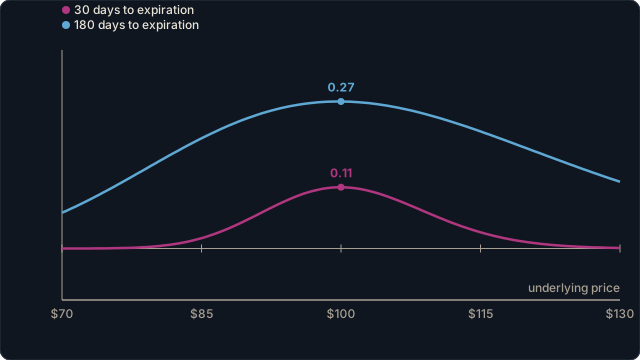
Vega is highest for at-the-money options and lower for deep in-the-money or far out-of-the-money options. The intuition: an IV change most affects the probability of an ambiguous outcome. ATM options are most uncertain about whether they finish in or out of the money, so they respond most to a change in the distribution of expected outcomes.
| Moneyness | Relative vega | Reason |
|---|---|---|
| Deep ITM | Low | Outcome is nearly certain (will expire ITM); IV changes the amount slightly but not the probability |
| ATM | Highest | Outcome is most uncertain; any change in expected volatility has maximum impact on option value |
| Far OTM | Low | Very small probability of finishing ITM; IV change moves that probability by a small amount |
Vega and Time to Expiration
Vega increases with time to expiration for a given strike. A longer-dated option has more time for a volatility-driven move to materialize, making it more sensitive to IV changes. A one-week ATM option has a much lower vega than a three-month ATM option at the same strike.
This means IV changes affect long-dated options (LEAPS) more severely than short-dated options in dollar terms. Traders holding long-dated options are exposed to significant vega risk if IV compresses — a common outcome once an anticipated event passes.
Drill vega flashcards or model a long straddle — the textbook positive-vega position — in the P&L calculator.
Options Profit CalculatorRelated Concepts
- Delta — first-order sensitivity to the underlying price
- Gamma — rate of change of delta
- Intrinsic vs Extrinsic Value — vega drives the extrinsic component
- ITM vs OTM — moneyness determines vega magnitude
More Strategy Guides
- Long Straddle — maximum positive-vega position
- Iron Butterfly — negative-vega position; benefits from IV falling
- Iron Condor — negative-vega position with wider profitable range
- Calendar Spread — vega-positive due to long far-dated leg vs short near-dated leg
Frequently Asked Questions
- What is vega in options?
- Vega measures how much an option's price changes for each one-percentage-point increase in implied volatility. For example, an option with a vega of 0.12 gains $0.12 per share ($12 per contract) in value when implied volatility rises by 1 percentage point. Vega is not a Greek letter — it is a made-up name but is universally used in options analysis.
- Which options have the highest vega?
- At-the-money options with longer time to expiration have the highest vega. Longer-dated options are more sensitive to volatility changes because there is more time for a volatility-driven move to affect the outcome. Deep in-the-money or far out-of-the-money options have lower vega relative to at-the-money options of the same expiration.
- What does positive vega mean for a position?
- Positive vega means the position benefits when implied volatility rises and loses value when implied volatility falls. Buying calls or puts creates positive vega. A long straddle is an example of a high positive-vega position — it gains value from any increase in implied volatility, regardless of which direction the underlying moves.
- What does negative vega mean?
- Negative vega means the position loses value when implied volatility rises and gains value when implied volatility falls. Selling options (writing calls or puts) creates negative vega. Short straddles, iron condors, and iron butterflies are negative-vega positions — they benefit from low or declining implied volatility.
Sources
- OCC — Characteristics and Risks of Standardized Options (options Greeks and risk factors)
- Cboe — Options Pricing and the Greeks
- FINRA — Options Investing Overview