Intrinsic vs Extrinsic Option Value: Formulas and Worked Examples
An option's premium has two components: intrinsic value, which is the amount it is in the money right now, and extrinsic value, which is everything else — driven by time remaining to expiration and implied volatility. At expiration, extrinsic value is always zero; an option settles purely at its intrinsic value.
Intrinsic Value
Intrinsic value is the amount by which an option is currently in the money. It is the value that could be captured by exercising the option immediately, ignoring transaction costs.
The max(0, …) ensures intrinsic value is never negative. An option that is out of the money has zero intrinsic value — it cannot be immediately exercised at a profit.
Extrinsic Value
Extrinsic value is the portion of the premium that remains after subtracting intrinsic value. It is also called time value, though extrinsic value is the more precise term because implied volatility — not just time — drives it.
Two inputs drive extrinsic value:
- Time to expiration: More time means more opportunity for the underlying to move, which buyers will pay for and sellers must be compensated for. Extrinsic value decreases as expiration approaches (time decay, measured by the Greek theta).
- Implied volatility: Higher implied volatility means the market expects larger price swings. Larger expected swings increase the probability that even an OTM option finishes in the money, raising extrinsic value across all strikes. This sensitivity is measured by the Greek vega.
Worked Decomposition Rows
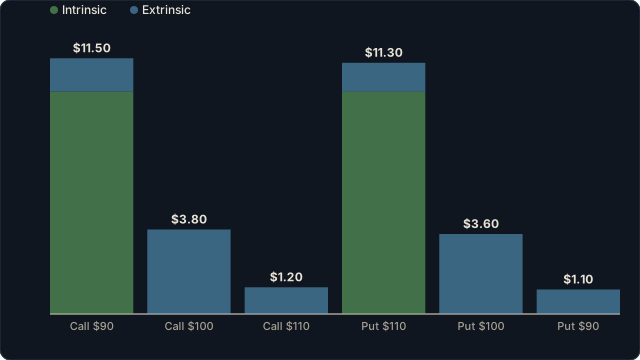
XYZ underlying at $100. All premiums are sample values for illustration. Arithmetic is shown for each row.
| Option | Strike | Moneyness | Premium | Intrinsic | Extrinsic |
|---|---|---|---|---|---|
| Call | $90 | ITM by $10 | $11.50 | max(0, 100−90) = $10.00 | $11.50 − $10.00 = $1.50 |
| Call | $100 | ATM | $3.80 | max(0, 100−100) = $0.00 | $3.80 − $0.00 = $3.80 |
| Call | $110 | OTM by $10 | $1.20 | max(0, 100−110) = $0.00 | $1.20 − $0.00 = $1.20 |
| Put | $110 | ITM by $10 | $11.30 | max(0, 110−100) = $10.00 | $11.30 − $10.00 = $1.30 |
| Put | $100 | ATM | $3.60 | max(0, 100−100) = $0.00 | $3.60 − $0.00 = $3.60 |
| Put | $90 | OTM by $10 | $1.10 | max(0, 90−100) = $0.00 | $1.10 − $0.00 = $1.10 |
Observation: the ATM call and ATM put have the highest extrinsic values ($3.80 and $3.60 respectively). The deep ITM options have the lowest extrinsic values ($1.50 and $1.30) — their premium is mostly intrinsic. The OTM options have moderate extrinsic values relative to their total premium, but zero intrinsic value.
Extrinsic Value Decays to Zero at Expiration
At expiration, no time remains and implied volatility becomes irrelevant to the terminal payoff. Every option settles at exactly its intrinsic value:
- A $95 call with the underlying at $102 at expiry: intrinsic = $7.00; extrinsic = $0. The option is worth exactly $7.00.
- A $110 call with the underlying at $105 at expiry: intrinsic = $0 (OTM); extrinsic = $0. The option expires worthless.
This property is why option buyers who are right about direction but wrong about timing can still lose money — the extrinsic component erodes even as the option moves in the money, if the move occurs slowly. The rate of this erosion is measured by theta (time decay).
Practical Relevance
Understanding intrinsic and extrinsic value matters for several common decisions:
- Early exercise: Exercising an American-style call early generally destroys the extrinsic value (the holder gives up any remaining time value). It is rarely optimal unless the option has nearly zero extrinsic value and a dividend is approaching (see covered call early-assignment risk).
- Rolling options: Closing a short option that has lost most of its extrinsic value and reopening at a new expiration lets the option seller capture a fresh round of extrinsic value. Rolling is a common practice in the wheel strategy and covered call cycles.
- Comparing strikes: Two strikes with the same intrinsic value but different premiums differ in extrinsic value — usually because of different time to expiration or different implied volatility at that strike (skew).
Use the P&L calculator to compare how at-expiration P&L differs from mid-term P&L (the difference is extrinsic value erosion).
Options Profit CalculatorRelated Concepts
- ITM vs OTM — moneyness definitions that determine intrinsic value
- Vega — how implied volatility drives extrinsic value
- Delta — how moneyness relates to price sensitivity
More Strategy Guides
- Covered Call — selling extrinsic value on a stock you own
- Cash-Secured Put — selling extrinsic value on a put you are willing to be assigned
- Calendar Spread — benefits from extrinsic decay differential between near and far expirations
- Long Straddle — buying extrinsic value on both sides of the market
Frequently Asked Questions
- What is intrinsic value in options?
- Intrinsic value is the amount by which an option is in the money. For a call, intrinsic value equals max(0, underlying price minus strike price). For a put, intrinsic value equals max(0, strike price minus underlying price). An option that is out of the money or at the money has zero intrinsic value — its entire premium is extrinsic.
- What is extrinsic value in options?
- Extrinsic value is the portion of an option's premium that exceeds its intrinsic value. It reflects time remaining to expiration and implied volatility. Formula: extrinsic value = premium minus intrinsic value. Extrinsic value decays to zero at expiration — an option can only settle at its intrinsic value on the expiration day.
- Does a deeply in-the-money option have extrinsic value?
- Yes, but less than an at-the-money option. A deep in-the-money option still has some extrinsic value representing the remaining time value and the chance of volatility affecting the outcome. At expiration, all extrinsic value is gone regardless of how deep in the money the option is.
- How does implied volatility affect extrinsic value?
- Higher implied volatility increases extrinsic value across all strikes and expirations. When the market expects larger price swings, option sellers demand a higher premium for the additional risk, and buyers are willing to pay more for the increased profit potential. Lower implied volatility reduces extrinsic value. This relationship is measured by the Greek called vega.
Sources
- OCC — Characteristics and Risks of Standardized Options (option pricing and value components)
- Cboe — Options Pricing Basics
- FINRA — Options Investing Overview