Vertical Spread Options: All 4 Types in One Guide
A vertical spread buys and sells two options of the same type (calls or puts) at different strikes but on the same underlying and expiration; the four verticals are bull call, bear call, bull put, and bear put. Every vertical has defined maximum profit, defined maximum loss, and a single breakeven — all knowable at entry.
What Makes a Spread “Vertical”
In an options chain, expirations run horizontally and strike prices run vertically. A vertical spread uses two options in the same expiration column at different strike rows — hence “vertical.” A horizontal spread (calendar) uses two expirations at the same strike; a diagonal combines both dimensions.
Vertical spreads are defined-risk: the long leg caps the short leg's potential loss, and the short leg caps the long leg's potential gain. The maximum loss and maximum profit are fixed at entry.
The Four Verticals: Comparison Table
| Name | Construction | Entry | Max profit | Max loss | Breakeven | Direction |
|---|---|---|---|---|---|---|
| Bull call | Long lower-strike call + short higher-strike call | Debit | Width − debit | Debit | Long strike + debit | Bullish |
| Bear call | Short lower-strike call + long higher-strike call | Credit | Credit | Width − credit | Short strike + credit | Bearish/neutral |
| Bull put | Short higher-strike put + long lower-strike put | Credit | Credit | Width − credit | Short strike − credit | Bullish/neutral |
| Bear put | Long higher-strike put + short lower-strike put | Debit | Width − debit | Debit | Long strike − debit | Bearish |
“Width” = the difference between the two strike prices. All P&L figures multiply by 100 shares per contract.
Worked Example: Bull Call Spread
All inputs are stated explicitly. Arithmetic is shown so every figure can be verified.
| Input | Value |
|---|---|
| Underlying (XYZ) | $100.00 |
| Long leg | Buy $100 call for $4.00 |
| Short leg | Sell $105 call for $1.50 |
| Net debit | $4.00 − $1.50 = $2.50 per share ($250 per contract) |
| Width | $105 − $100 = $5.00 |
| Days to expiration | 30 |
| Capital required | $2.50 × 100 = $250 (net debit paid in full — no additional margin for a fully-paid debit spread) |
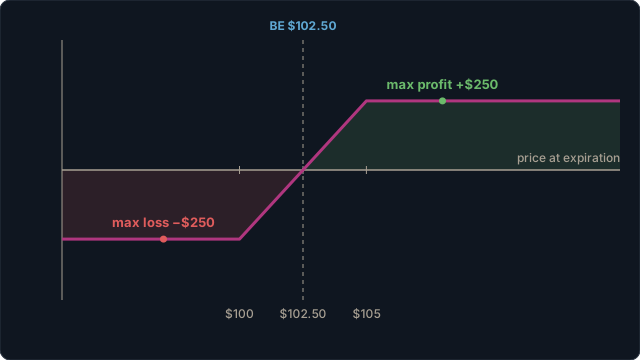
Max profit: ($5.00 − $2.50) × 100 = $250 (XYZ at or above $105 at expiration)
Max loss: $2.50 × 100 = $250 (XYZ at or below $100 at expiration)
Breakeven: $100 + $2.50 = $102.50
Payoff at five expiration prices
| XYZ at expiry | Long $100 call | Short $105 call | Net option value | P&L (vs. $2.50 debit) | Note |
|---|---|---|---|---|---|
| $95 | $0 | $0 | $0 | −$250 | Max loss; both expire worthless |
| $100 | $0 | $0 | $0 | −$250 | Max loss; exactly at long strike |
| $102.50 | $2.50 | $0 | $2.50 | $0 | Breakeven |
| $105 | $5.00 | $0 | $5.00 | +$250 | Max profit; short call at the money |
| $115 | $15.00 | $10.00 | $5.00 | +$250 | Capped at width − debit; short call limits gain |
Arithmetic check for $115: long call = max(0, $115 − $100) = $15.00; short call obligation = max(0, $115 − $105) = $10.00; net value = $15.00 − $10.00 = $5.00; P&L = ($5.00 − $2.50) × 100 = +$250. ✓
When Each Vertical Appears
Traders select among the four verticals based on directional view and whether they prefer to pay a debit or receive a credit:
- Bull call: Traders expecting the underlying to rise above the long strike by expiration. Debit paid. The short higher strike reduces cost but caps profit. A common choice when the underlying is near the long strike and upside potential is seen as moderate.
- Bear call: Traders expecting the underlying to stay below the short (lower) strike. Credit received. The position profits from the underlying not rising above the short strike. The long higher strike provides defined-risk protection. See Bear Call Spread for a worked example.
- Bull put: Traders expecting the underlying to stay above the short (higher) strike. Credit received. Profits from the underlying not falling below the short strike. The long lower strike provides defined-risk protection. See Bull Put Spread for a worked example.
- Bear put: Traders expecting the underlying to fall below the long (higher) strike by expiration. Debit paid. Mirrors the bull call in structure but with puts and a bearish directional view.
Credit vs. Debit: Capital Allocation
A debit spread requires paying the net premium upfront. The maximum loss equals the debit; the maximum profit equals the spread width minus the debit. A credit spread receives the net premium upfront. The maximum profit equals the credit; the maximum loss equals the spread width minus the credit. Total capital at risk (max loss) is the same mathematical formula for both debit and credit spreads of the same width — the difference is in the timing and direction of the initial cash flow.
For a $5-wide spread: a bull call debit spread and a bull put credit spread on the same underlying and expiration with appropriately chosen strikes can express a similar directional view. The choice between them depends on the specific strikes available and relative premiums (put-call skew).
Model any vertical spread in the P&L calculator — input the long call (or put) parameters and subtract the short leg's credit to compare breakevens.
Options Profit CalculatorMore Strategy Guides
- Bull Put Spread — credit vertical; fully worked put-side example
- Bear Call Spread — credit vertical; fully worked call-side example
- Iron Condor — combines a bull put spread + bear call spread in one position
- Iron Butterfly — two verticals sharing the same short strike at ATM
- Covered Call — directional trade; for comparison with vertical spread cost
- Protective Put — long put hedge; vertical spread is the defined-risk alternative
Frequently Asked Questions
- What is a vertical spread?
- A vertical spread is an options strategy that buys and sells two options of the same type (both calls or both puts) on the same underlying and expiration date, but with different strike prices. The term 'vertical' refers to the options occupying different price levels on the same expiration column in an options chain. All four verticals — bull call, bear call, bull put, and bear put — follow this structure.
- What is the maximum profit on a bull call spread?
- The maximum profit on a bull call spread equals the width between the two strikes minus the net debit paid, multiplied by 100 per contract. Example: buy $100 call for $4.00, sell $105 call for $1.50 — net debit $2.50, width $5.00, maximum profit = ($5.00 minus $2.50) times 100 = $250. Maximum profit is realized when the underlying closes at or above the short (higher) strike at expiration.
- What is the difference between a debit spread and a credit spread?
- A debit spread costs money to enter — the premium paid for the long option exceeds the premium received for the short option. Bull call spreads and bear put spreads are debit spreads. A credit spread collects a net premium at entry — the premium received for the short option exceeds the premium paid for the long option. Bear call spreads and bull put spreads are credit spreads.
- How does a vertical spread limit risk compared to a naked option?
- A vertical spread limits both maximum profit and maximum loss to known dollar amounts at entry. Buying a call alone has undefined maximum profit and a maximum loss of the premium paid; the long call's loss is bounded but the upside is unlimited. In a bull call spread, adding a short higher-strike call caps the profit but also reduces the cost, lowering the maximum loss and the breakeven point compared to the long call alone.
Sources
- OCC — Characteristics and Risks of Standardized Options (spread strategy definitions and mechanics)
- Cboe — Bull Call Spread Strategy Overview
- FINRA — Options Investing Overview