Covered Call: Max Profit, Formula and Worked Example
A covered call is an options strategy in which a trader holds 100 shares of a stock and simultaneously sells one out-of-the-money call option on those same shares; the long shares “cover” the obligation to deliver if the call is exercised. Maximum profit is capped at the premium received plus the difference between the call strike and the share cost basis; maximum loss equals the full cost basis minus the premium if the stock falls to zero.
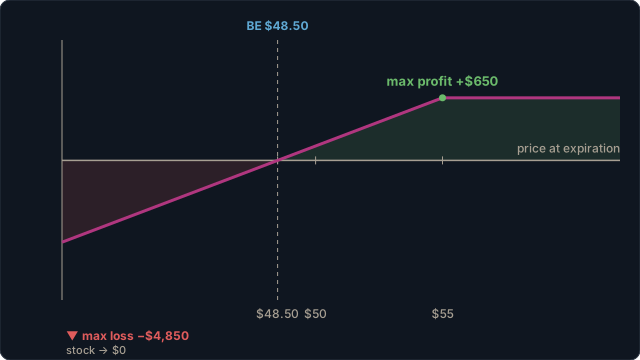
Construction
A covered call has exactly two components, both on the same underlying and typically the same expiration cycle.
| Leg | Position | Quantity | Role |
|---|---|---|---|
| Long stock | Buy (or already own) shares | 100 shares per contract | Covers the short call assignment obligation |
| Short call | Sell 1 OTM call | 1 contract = 100 shares | Generates premium income; strike above current price |
The call strike is typically 5–15% above the current share price (out of the money). A lower strike collects more premium but caps profit sooner; a higher strike collects less premium but gives the shares more room to appreciate before the cap is hit.
Payoff Formulas at Expiration
The maximum profit is a ceiling — the short call caps any gain above the strike. The maximum loss assumes the stock goes to zero; in practice losses are bounded by the stock price, but the formula above represents the theoretical maximum. The premium permanently reduces the effective cost basis of the shares, lowering the breakeven point.
Worked Example
All inputs are stated explicitly. Arithmetic is shown so every figure can be verified.
| Input | Value |
|---|---|
| Shares purchased | 100 shares of XYZ |
| Share cost basis | $50.00 per share ($5,000 total) |
| Short call strike | $55 (OTM by $5) |
| Days to expiration | 30 |
| Premium received | $1.50 per share ($150 total) |
| Capital required | $50.00 × 100 = $5,000 (full share purchase price) |
Max profit: ($1.50 + ($55 − $50)) × 100 = $6.50 × 100 = $650
Max loss: ($50.00 − $1.50) × 100 = $48.50 × 100 = $4,850 (stock to zero)
Breakeven: $50.00 − $1.50 = $48.50 per share
Payoff at five expiration prices
| XYZ at expiry | Stock gain/loss | Premium kept | Net P&L | Note |
|---|---|---|---|---|
| $40 | −$1,000 | +$150 | −$850 | Call expires worthless |
| $48.50 | −$150 | +$150 | $0 | Breakeven |
| $50 | $0 | +$150 | +$150 | Stock flat; full premium kept |
| $55 | +$500 | +$150 | +$650 | Max profit; shares called away |
| $62 | +$500* | +$150 | +$650 | *Capped; called away at $55 |
At $62, the stock would yield ($62 − $50) × 100 = $1,200 if held outright. The covered call captures only $500 on the shares (called away at $55) plus the $150 premium = $650. The $550 difference is the cost of selling the upside.
Assignment and Expiration Mechanics
U.S. equity options are American-style, meaning the holder may exercise at any time before expiration. At expiration, standard exercise rules apply:
- In the money (XYZ > $55): The OCC automatically exercises the call on behalf of the holder. The covered call writer sells 100 shares at $55 and the position closes.
- At the money (XYZ = $55): Exercise is uncertain. The OCC exercises calls with $0.01 or more of intrinsic value; at exactly $55 the call has zero intrinsic value and typically expires worthless.
- Out of the money (XYZ < $55): The call expires worthless. The writer keeps the full $150 premium and retains the 100 shares.
Early assignment risk. Covered call writers face early assignment risk primarily around ex-dividend dates. When a call is deep in the money and a dividend is approaching, the call holder may exercise early to capture the dividend. This is especially relevant for calls with little time value remaining. If early assignment occurs before ex-dividend, the writer will not receive the dividend — the shares are called away the night before. Monitoring the ex-dividend date and the remaining time value of any deep-ITM short call is standard risk management practice.
Source: OCC, Characteristics and Risks of Standardized Options (Cboe/OCC).
Margin and Capital Requirement
A covered call does not require margin because the long shares provide full collateral for the short call. Brokers classify the covered call as a Level 1 or Level 2 options strategy — the lowest tier — because the maximum loss is defined and the position is fully collateralized. The full purchase price of the shares ($50 × 100 = $5,000 in the example) must be in the account. No additional buying power is consumed by the short call itself.
An uncovered call (selling a call without owning shares) is a different strategy with theoretically unlimited loss and requires margin approval at a higher level. That is not a covered call.
Covered Call vs. Cash-Secured Put
A covered call (short a $55 call, long stock at $50) and a cash-secured put (short a $50 put, cash equal to $5,000) with the same strike and expiration are synthetic equivalents at expiration — a consequence of put-call parity. Both generate similar net premium and carry equivalent expiration-day profit and loss. Differences emerge in the path to expiration (early assignment timing, dividend rights, and margin treatment), not in the terminal payoff.
| Feature | Covered Call | Cash-Secured Put |
|---|---|---|
| Capital held | 100 shares (market risk) | Cash equal to strike × 100 |
| Receives dividend | Yes (until assigned) | No |
| Early assignment risk | Call: ex-dividend day | Put: rarely exercised early |
| Outcome if OTM at expiry | Keep shares + premium | Keep cash + premium |
| Outcome if ITM at expiry | Shares called at strike | Buy shares at strike; effective cost = strike − premium |
Drill covered call flashcards or model this position in the P&L calculator.
Options Profit CalculatorMore Strategy Guides
- Cash-Secured Put — synthetic equivalent at expiration; different path mechanics
- Protective Put — long stock + long put, the downside-hedged counterpart
- Wheel Strategy — covered call as Stage 2 of the CSP-to-CC cycle
- Bull Put Spread — short higher-strike put + long lower-strike put
- Bear Call Spread — short lower-strike call + long higher-strike call
- Iron Condor — short OTM put spread + short OTM call spread
- Iron Butterfly — short ATM straddle + long OTM wings
- Calendar Spread — short near-dated + long far-dated, same strike
Frequently Asked Questions
- What is a covered call?
- A covered call is a two-leg strategy: long 100 shares of a stock plus short 1 call option on the same underlying, with a strike above the current share price. The word 'covered' means the short call obligation is backed by the long shares — if assigned, you deliver shares you already own rather than buying them at market.
- What is the maximum profit on a covered call?
- Maximum profit equals the premium received plus the difference between the short call strike and your cost basis, multiplied by 100. Example: cost basis $50.00, sell $55 call for $1.50 — max profit = ($1.50 + $5.00) × 100 = $650. The maximum is realized when the stock closes at or above the short strike at expiration and the shares are called away.
- What is the covered call breakeven?
- Breakeven equals cost basis minus the premium received. Example: cost basis $50.00, premium $1.50 — breakeven = $50.00 − $1.50 = $48.50. Below $48.50, the position loses money at expiration despite the premium collected.
- Can a covered call be assigned early?
- Yes. American-style equity calls can be exercised by the holder at any time before expiration. Early exercise is most likely just before a stock's ex-dividend date when the call is deep in the money, because the holder may exercise to capture the dividend. Covered call writers should monitor ex-dividend dates for deep in-the-money short calls. (Source: OCC)
- Is a covered call bullish or neutral?
- A covered call has a neutral-to-mildly-bullish outlook. The strategy profits most when the stock finishes near or just above the short call strike at expiration. Profit is capped above the strike — the position underperforms a naked long-stock position if the stock rallies significantly.
Sources
- OCC — Characteristics and Risks of Standardized Options (options assignment and exercise mechanics)
- Cboe — Covered Call Strategy Overview
- FINRA — Options Investing Overview