ITM vs OTM Options: Definitions, Intrinsic Value, and Auto-Exercise
In-the-money (ITM), at-the-money (ATM), and out-of-the-money (OTM) describe the relationship between an option's strike price and the current underlying price; for a call, ITM means the stock is above the strike, while for a put, ITM means the stock is below the strike. Only ITM options have intrinsic value — OTM options' entire premium is extrinsic.
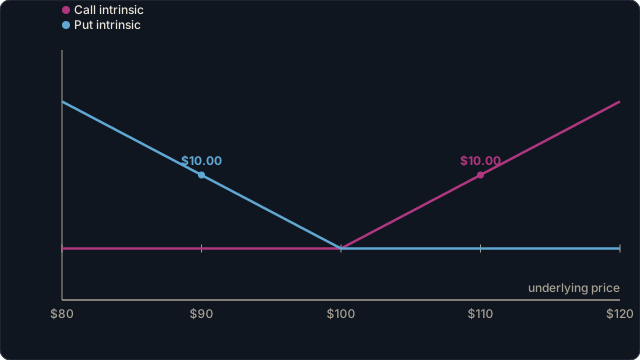
Definitions: Calls and Puts
| Moneyness | Call condition | Put condition | Intrinsic value |
|---|---|---|---|
| In the money (ITM) | Underlying > Strike | Underlying < Strike | Positive |
| At the money (ATM) | Underlying ≈ Strike | Underlying ≈ Strike | Zero (or negligible) |
| Out of the money (OTM) | Underlying < Strike | Underlying > Strike | Zero |
The condition is always evaluated relative to the current underlying price, not where the underlying was when the option was purchased. A call that was OTM when bought can become ITM if the underlying rises above the strike.
Intrinsic Value at Three Example Spots
Underlying XYZ currently at $100. Arithmetic is shown for each option.
| Option | Strike | Underlying | Moneyness | Intrinsic value |
|---|---|---|---|---|
| Call | $95 | $100 | ITM ($5 in the money) | max(0, $100 − $95) = $5.00 |
| Call | $100 | $100 | ATM | max(0, $100 − $100) = $0.00 |
| Call | $110 | $100 | OTM ($10 out of the money) | max(0, $100 − $110) = $0.00 |
| Put | $105 | $100 | ITM ($5 in the money) | max(0, $105 − $100) = $5.00 |
| Put | $100 | $100 | ATM | max(0, $100 − $100) = $0.00 |
| Put | $90 | $100 | OTM ($10 out of the money) | max(0, $90 − $100) = $0.00 |
Premium Composition: Intrinsic + Extrinsic
Every option premium consists of two components:
An OTM option's entire premium is extrinsic — buyers are paying for the possibility (not the certainty) that the underlying will move past the strike before expiration. An ITM option carries both intrinsic and extrinsic components: the intrinsic portion reflects the current in-the-money amount, and the extrinsic portion reflects remaining time and volatility.
Example: XYZ at $100. A $95 call trading at $6.50. Intrinsic = $5.00. Extrinsic = $6.50 − $5.00 = $1.50.
OCC Auto-Exercise at Expiration
At expiration, the OCC (Options Clearing Corporation) applies a standard exercise rule for equity options:
- $0.01 or more in the money: The OCC automatically exercises the option on behalf of the holder. For a call with a $95 strike and underlying at $100.05 at expiration, the option is automatically exercised: the holder buys 100 shares at $95, and a call writer on the other side is assigned the obligation to deliver them.
- Less than $0.01 in the money (or out of the money): The option expires worthless under the standard rule. The holder may submit contrary exercise instructions to exercise even a slightly OTM option, but this is non-standard and requires prior arrangement with the broker.
- Exactly at the money: Zero intrinsic value; typically expires worthless under the $0.01 rule.
This rule is particularly relevant for covered call writers who want to know if their short call will be assigned, and for cash-secured put sellers who want to know if they will be assigned shares. Source: OCC, Characteristics and Risks of Standardized Options.
Moneyness and Delta
Moneyness is closely related to delta. An ATM call typically has a delta near 0.50; a deep ITM call has a delta approaching 1.00; a far OTM call has a delta approaching 0. This relationship is definitional: deep ITM options behave more like the underlying itself (high delta), while far OTM options are largely insensitive to small underlying moves (low delta). See Delta Explained for the full treatment.
Model ITM, ATM, and OTM strikes in the P&L calculator to compare max profit, max loss, and breakeven across different moneyness levels.
Options Profit CalculatorRelated Concepts
- Intrinsic vs Extrinsic Value — full decomposition of option premium
- Delta — how moneyness maps to price sensitivity
- Gamma — rate of change of delta as moneyness shifts
More Strategy Guides
- Covered Call — short OTM call; assignment occurs if the call goes ITM at expiry
- Cash-Secured Put — short OTM put; assignment occurs if put goes ITM at expiry
- Bull Put Spread — short OTM put + long further-OTM put
- Iron Condor — profit zone is bounded by OTM strikes on both sides
Frequently Asked Questions
- What does in-the-money (ITM) mean for a call option?
- A call option is in the money when the underlying stock price is above the option's strike price. For example, a $95 call is in the money when the stock trades at $100 — it has intrinsic value of $5 (stock price minus strike price). At expiration, the OCC automatically exercises calls that are $0.01 or more in the money.
- What does out-of-the-money (OTM) mean for a put option?
- A put option is out of the money when the underlying stock price is above the put's strike price. For example, a $90 put is out of the money when the stock trades at $100. An out-of-the-money put has zero intrinsic value; its entire premium consists of extrinsic (time) value.
- What is an at-the-money (ATM) option?
- An at-the-money option has a strike price equal to (or very close to) the current underlying price. ATM options have approximately zero intrinsic value and the highest extrinsic value for a given expiration. Delta on an ATM call is typically near 0.50 and on an ATM put near -0.50.
- What is the OCC auto-exercise threshold at expiration?
- The OCC (Options Clearing Corporation) automatically exercises any option that is $0.01 or more in the money at expiration, on behalf of the holder. An option that expires exactly at the strike (zero intrinsic value) will typically expire worthless and is not automatically exercised. Holders can submit contrary instructions to their broker, but the default rule is $0.01 in the money triggers automatic exercise.
Sources
- OCC — Characteristics and Risks of Standardized Options (auto-exercise rules and exercise mechanics)
- Cboe — Options Pricing Basics
- FINRA — Options Investing Overview