Cash-Secured Put: Setup, Max Profit and Worked Example
A cash-secured put is the sale of 1 put option backed by enough cash in the account to purchase 100 shares at the strike price if assigned. Maximum profit is the premium received; maximum loss is the full strike price minus the premium, realized only if the stock falls to zero.
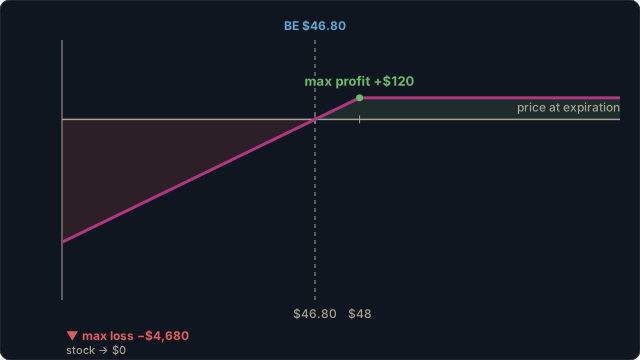
Construction
A cash-secured put has two components that must both be in place simultaneously.
| Component | Action | Amount | Role |
|---|---|---|---|
| Short put | Sell 1 put option | 1 contract = 100 shares | Generates premium income; obligates purchase at strike if assigned |
| Cash collateral | Hold cash in account | Strike × 100 | Secures the assignment obligation; no margin borrowed |
The strike is typically at or slightly below the current stock price (at-the-money or out-of-the-money). A higher strike collects more premium but increases the chance of assignment; a lower strike collects less but has a lower breakeven. The cash collateral requirement means the strategy consumes capital equal to the full stock purchase value.
Payoff Formulas at Expiration
Maximum loss assumes the stock falls to zero and 100 shares must be purchased at the strike. In practice, a stock reaching zero is rare; the more relevant risk is the size of the unrealized loss if the stock drops significantly below the breakeven.
Worked Example
| Input | Value |
|---|---|
| Underlying (XYZ) | $50.00 |
| Short put strike | $48 (OTM by $2) |
| Days to expiration | 30 |
| Premium received | $1.20 per share ($120 total) |
| Cash collateral required | $48 × 100 = $4,800 |
Max profit: $1.20 × 100 = $120 (put expires worthless)
Max loss: ($48.00 − $1.20) × 100 = $46.80 × 100 = $4,680 (stock to zero)
Breakeven: $48.00 − $1.20 = $46.80 per share
Payoff at five expiration prices
| XYZ at expiry | Put P&L | Net P&L | Note |
|---|---|---|---|
| $40 | Assigned: buy at $48, stock worth $40 → −$800 + $120 = −$680 | −$680 | Put ITM; unrealized stock loss after assignment |
| $46.80 | Assigned: buy at $48, stock worth $46.80 → −$120 + $120 = $0 | $0 | Breakeven at effective cost basis |
| $48 | Expires ATM (roughly worthless) | +$120 | Max profit; full premium kept |
| $50 | Expires OTM (worthless) | +$120 | Max profit; full premium kept |
| $55 | Expires OTM (worthless) | +$120 | Max profit; full premium kept |
At $40: you buy 100 shares at the strike ($48) via assignment, paying $4,800. The shares are immediately worth only $40 × 100 = $4,000, a $800 unrealized loss. The $120 premium offsets part of it: net P&L = −$800 + $120 = −$680. You now hold 100 shares with an effective cost basis of $46.80.
Assignment and Expiration Mechanics
A short put is a commitment to buy 100 shares at the strike if the holder exercises. For American-style equity puts:
- OTM at expiration (XYZ ≥ $48): The put expires worthless. The seller keeps the full $120 premium and all cash collateral is returned.
- ITM at expiration (XYZ < $48): The OCC exercises the put on behalf of the holder. The seller buys 100 shares at $48 via assignment, paying $4,800 from the collateral. Effective cost basis = $48 − $1.20 = $46.80.
- Early assignment: Put holders rarely exercise early because doing so gives up remaining time value. Early exercise of a put is most common on deep-ITM puts just before expiration or in certain dividend situations. (Source: OCC)
After assignment, the trader owns 100 shares at an effective cost basis of $46.80. The position can then be managed as a long-stock position — for example, by immediately selling a covered call to generate additional income.
Margin and Capital Requirement
In a cash-secured put, the full strike value × 100 ($4,800 in the example) must be available in the account as cash or cash equivalents. The premium received ($120) reduces the net capital at risk. No additional margin is borrowed — the word “cash-secured” specifically means the position is fully collateralized with cash rather than margin.
A naked put (same trade without full cash collateral) requires margin, not full cash, and is a different strategy with different broker approval requirements. This guide covers only the fully cash-secured version.
Cash-Secured Put vs. Covered Call
These two strategies are closely related through put-call parity. At the same underlying, strike, and expiration, their terminal payoffs at expiration are nearly identical.
| Feature | Cash-Secured Put | Covered Call |
|---|---|---|
| Capital held | Cash = strike × 100 | 100 shares (market risk from purchase) |
| Receives dividend | No (no shares held) | Yes (shares held until assignment) |
| Outcome if OTM at expiry | Keep cash + premium; no shares | Keep shares + premium |
| Outcome if ITM at expiry | Buy shares at strike; effective cost = strike − premium | Shares called away at strike |
| Early assignment risk | Low (put holders rarely exercise early) | Higher (call holders exercise before ex-div) |
The “wheel” strategy sequences these: sell a cash-secured put; if assigned, own shares; immediately sell a covered call; if called away, sell another cash-secured put, and so on — collecting premium at each step.
Drill cash-secured put flashcards or model this position in the P&L calculator.
Options Profit CalculatorMore Strategy Guides
- Covered Call — synthetic equivalent at expiration; Stage 2 if CSP is assigned
- Wheel Strategy — CSP as Stage 1 of the full wheel cycle
- Protective Put — long stock + long put, downside hedge after assignment
- Bull Put Spread — defined-risk version of the short put
- Bear Call Spread — short lower-strike call + long higher-strike call
- Iron Condor — short OTM put spread + short OTM call spread
- Iron Butterfly — short ATM straddle + long OTM wings
- Calendar Spread — short near-dated + long far-dated, same strike
Frequently Asked Questions
- What is a cash-secured put?
- A cash-secured put is the sale of 1 put option while holding enough cash in the account to cover the full cost of buying 100 shares at the strike price. The cash collateral equals strike × 100. The strategy generates premium income and — if the put is assigned — results in buying shares at an effective discount equal to the strike minus the premium.
- What is the maximum profit on a cash-secured put?
- Maximum profit equals the premium received. It is achieved when the underlying closes at or above the short put strike at expiration and the put expires worthless.
- What is the breakeven for a cash-secured put?
- Breakeven equals the strike price minus the premium received. Example: sell $48 put for $1.20 — breakeven = $48.00 − $1.20 = $46.80. Below $46.80, the position loses money at expiration despite keeping the premium.
- What happens if a cash-secured put is assigned?
- If the underlying closes below the strike at expiration, the put is assigned and the seller buys 100 shares at the strike price. The effective cost basis is strike minus premium. Example: sell $48 put for $1.20, assigned — effective cost basis = $48.00 − $1.20 = $46.80 per share. The position becomes equivalent to holding long stock at that adjusted cost.
- How does a cash-secured put relate to a covered call?
- At the same strike and expiration, a cash-secured put and a covered call produce nearly identical profit and loss at expiration — a relationship described by put-call parity. If the put is assigned, the resulting long-stock position can immediately become a covered call by selling an OTM call. This sequence is called the wheel strategy.
Sources
- OCC — Characteristics and Risks of Standardized Options (put exercise and assignment)
- Cboe — Options Education
- FINRA — Options Investing Overview