Long Straddle: Construction, Max Loss, Breakevens and Worked Example
A long straddle buys one at-the-money call and one at-the-money put at the same strike and expiration; maximum loss is limited to the total premium paid, realized only if the underlying closes exactly at the strike at expiration. The strategy profits from a large move in either direction — upside profit is unlimited, downside profit is bounded by the stock reaching zero.
Construction
| Leg | Position | Strike | Role |
|---|---|---|---|
| Long call | Buy 1 ATM call | Same strike (K) | Profits if underlying rises above K + total premium |
| Long put | Buy 1 ATM put | Same strike (K) | Profits if underlying falls below K − total premium |
Both legs expire on the same date. The total cost (net debit) is the sum of the two premiums. There is no credit received — the straddle is a debit strategy. The combined premium represents the maximum dollar loss on the position.
Payoff Formulas at Expiration
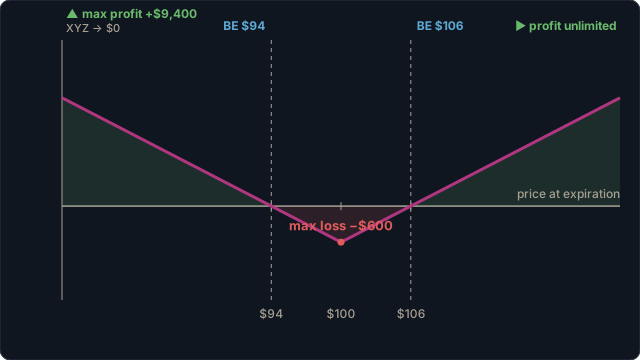
The position loses money whenever the underlying finishes between the two breakevens at expiration. Outside that range, the in-the-money leg outpaces the combined premium, and the position becomes profitable.
Worked Example
All inputs are stated explicitly. Arithmetic is shown so every figure can be verified.
| Input | Value |
|---|---|
| Underlying (XYZ) | $100.00 |
| Strike (K) | $100 (ATM) |
| Long call premium | $3.00 per share ($300 per contract) |
| Long put premium | $3.00 per share ($300 per contract) |
| Total premium | $6.00 per share ($600 per contract) |
| Days to expiration | 30 |
| Capital required | $600 per contract (total premium paid in full — no additional margin) |
Max loss: $6.00 × 100 = $600 (XYZ closes exactly at $100)
Upper breakeven: $100 + $6 = $106
Lower breakeven: $100 − $6 = $94
Max profit (upside): Unlimited (XYZ rises far above $106)
Max profit (downside): ($100 − $6) × 100 = $9,400 (XYZ to zero)
Payoff at five expiration prices
| XYZ at expiry | Call value | Put value | Total option value | Net P&L | Note |
|---|---|---|---|---|---|
| $80 | $0 | $20 | $20 | +$1,400 | Put far ITM |
| $94 | $0 | $6 | $6 | $0 | Lower breakeven |
| $100 | $0 | $0 | $0 | −$600 | Max loss; both legs expire worthless |
| $106 | $6 | $0 | $6 | $0 | Upper breakeven |
| $120 | $20 | $0 | $20 | +$1,400 | Call far ITM |
Arithmetic check for $80: put value = max(0, $100 − $80) = $20.00; net = $20.00 − $6.00 (total premium) = $14.00/share × 100 = +$1,400. ✓
Arithmetic check for $120: call value = max(0, $120 − $100) = $20.00; net = $20.00 − $6.00 = $14.00/share × 100 = +$1,400. ✓
Greeks: Long Gamma and Long Vega
A long straddle is a long-gamma, long-vega position. These two Greek exposures are central to understanding when and why the strategy works:
- Long gamma: As the underlying moves away from the strike in either direction, the delta of the in-the-money leg increases (in the favorable direction), accelerating gains. The further the underlying moves, the faster gains compound. This convexity is positive gamma at work. See Gamma Explained.
- Long vega: Any increase in implied volatility increases the value of both the long call and the long put. The straddle benefits from the market expecting a larger move, regardless of direction. See Vega Explained.
The strategy's two conditions for profit — a large realized move, or an increase in implied volatility — are independent. In practice, both often coincide: if the underlying makes a large move, IV may expand as well, providing a double benefit to the long straddle holder.
Assignment and Expiration Mechanics
At expiration, standard OCC rules apply. The in-the-money leg is automatically exercised if it has $0.01 or more of intrinsic value. If the underlying closes exactly at the strike, both legs expire worthless and the full premium is lost. If the underlying is $0.01 or more above the strike, only the call is exercised (the put expires worthless); if $0.01 or more below, only the put is exercised.
Long straddle holders do not face assignment risk — they are buyers, not sellers. The risk is limited to the total premium paid.
Long Straddle vs. Iron Butterfly
The iron butterfly is the structural opposite of a long straddle. It sells an ATM straddle (short ATM call + short ATM put) and buys OTM wings for defined risk. The iron butterfly collects a net credit and profits from the underlying staying near the strike (negative gamma, negative vega). The long straddle pays a net debit and profits from the underlying moving far from the strike (positive gamma, positive vega). The two strategies are mirror images in terms of P&L shape and Greek exposures.
| Feature | Long Straddle | Iron Butterfly |
|---|---|---|
| Entry cost | Debit (pay premium) | Credit (receive premium) |
| Profit from | Large move away from strike | Underlying staying near strike |
| Max loss | Total premium (at the strike) | Wing width minus net credit |
| Gamma | Positive | Negative |
| Vega | Positive | Negative |
Drill straddle flashcards or model the long straddle in the P&L calculator to see the V-shaped payoff curve.
Options Profit CalculatorRelated Concepts
- Gamma — positive gamma is the source of the straddle's accelerating profits
- Vega — positive vega means the straddle benefits from rising implied volatility
- ITM vs OTM — both legs start ATM; one becomes ITM as the underlying moves
More Strategy Guides
- Iron Butterfly — structural opposite; profits from the underlying staying near strike
- Iron Condor — wider profit range version of the short straddle concept
- Vertical Spread — directional spread using two same-type options
- Calendar Spread — also long vega; profits from the near-dated leg decaying faster
Frequently Asked Questions
- What is a long straddle?
- A long straddle is an options strategy that buys one at-the-money call and one at-the-money put on the same underlying, with the same strike price and expiration date. The position profits when the underlying makes a large move in either direction by expiration. Maximum loss is the total premium paid for both options, realized if the underlying closes exactly at the strike at expiration.
- What is the maximum profit on a long straddle?
- The upside maximum profit on a long straddle is unlimited — if the stock rises far above the strike, the call gains without a ceiling. The downside maximum profit equals the strike price minus the total premium, times 100 per contract — the stock can fall no further than zero. Example: strike $100, total premium $6 — maximum downside profit is ($100 minus $6) times 100 = $9,400 per contract.
- How are the long straddle breakevens calculated?
- There are two breakevens for a long straddle: an upper breakeven equal to the strike plus the total premium, and a lower breakeven equal to the strike minus the total premium. Example: strike $100, total premium $6 — upper breakeven $106, lower breakeven $94. The position profits at expiration when the underlying is above $106 or below $94.
- How do gamma and vega affect a long straddle?
- A long straddle is long gamma and long vega. Long gamma means the position benefits from large moves in the underlying — the further the stock moves from the strike, the faster the profitable option gains value. Long vega means the position benefits when implied volatility rises, because higher volatility increases the value of both the long call and the long put.
Sources
- OCC — Characteristics and Risks of Standardized Options (exercise mechanics and strategy definitions)
- Cboe — Straddles and Strangles
- FINRA — Options Investing Overview