Gamma: Rate of Change of Delta — Options Greeks Guide
Gamma is the rate of change of an option's delta for every $1 move in the underlying; long options have positive gamma and short options have negative gamma. A call with delta 0.50 and gamma 0.08 will have a new delta of approximately 0.58 after the underlying rises $1.
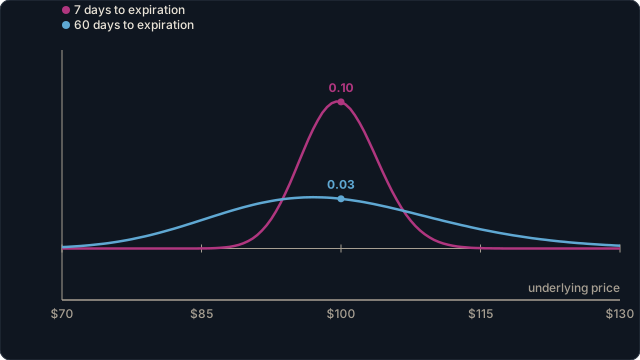
What Gamma Measures
Delta tells you how much an option moves per $1 in the underlying right now. Gamma tells you how much that sensitivity itself changes per $1 move. Together, delta and gamma describe both the first- and second-order behavior of an option's price:
Example: option with delta 0.50 and gamma 0.08. Underlying rises $1 → new delta ≈ 0.50 + 0.08 = 0.58. If the underlying rises another $1 (and gamma is approximately stable), delta increases again ≈ 0.58 + 0.08 = 0.66.
This acceleration of delta is the source of the convexity benefit that long-option holders receive. Because delta rises in the favorable direction, gains accumulate faster than losses — a property that comes at the cost of the option premium.
Sign Convention
| Position | Gamma sign | Effect |
|---|---|---|
| Long call | Positive (+) | Delta increases as underlying rises; gains accelerate |
| Long put | Positive (+) | Delta decreases (becomes more negative) as underlying falls; gains accelerate |
| Short call | Negative (−) | Delta decreases as underlying rises; losses accelerate against seller |
| Short put | Negative (−) | Delta increases as underlying falls; losses accelerate against seller |
Gamma is always positive for long options and negative for short options, regardless of whether the option is a call or a put. The sign does not depend on direction (bullish or bearish) — it depends only on whether you are long or short the optionality.
Why Gamma Peaks ATM Near Expiration
Gamma is not uniformly distributed across strikes and expirations. It concentrates where uncertainty about the final outcome is highest:
| Condition | Gamma level | Reason |
|---|---|---|
| ATM, short time to expiry | Highest | A $1 move can flip the option from OTM (worthless) to ITM (valuable); delta is most uncertain |
| ATM, long time to expiry | Moderate | Outcome is uncertain, but there is enough time that delta changes slowly |
| Deep ITM, any expiry | Low | Delta is already near 1.00 — it has little room to increase further |
| Far OTM, any expiry | Low | Delta is already near 0 — a $1 move barely changes a very low probability of finishing ITM |
This concentration near ATM close to expiration is why strategies with short-dated short options (such as an iron butterfly or iron condor) face elevated gamma risk in the final days before expiration. A large move in the underlying can rapidly change the delta of the short options and alter the position's risk profile.
Worked Example: Delta Update via Gamma
All inputs are stated explicitly. Arithmetic is shown.
| Input | Value |
|---|---|
| Underlying (XYZ) | $100.00 |
| Call strike | $100 (ATM) |
| Initial delta | 0.50 |
| Gamma | 0.08 |
| Contracts | 1 (100 shares) |
Over a $1 move, delta itself changes, so the option's value change is approximately the average delta over the move: initial delta ± ½ × gamma.
Scenario A: XYZ rises $1 to $101
New delta ≈ 0.50 + 0.08 = 0.58
Dollar change in option value (per share): ≈ (0.50 + ½ × 0.08) × $1 = 0.54 × $1 = $0.54; contract gain: 0.54 × 100 = +$54
Scenario B: XYZ falls $1 to $99
New delta ≈ 0.50 − 0.08 = 0.42
Dollar change in option value (per share): ≈ −(0.50 − ½ × 0.08) × $1 = −0.46 × $1 = −$0.46; contract loss: −$46
For the same $1 move in either direction, the long call gains $54 on the way up but loses only $46 on the way down. This asymmetry is positive gamma at work: as the underlying rises, delta expands and the option gains at an accelerating rate; as the underlying falls, delta shrinks and the option loses at a decelerating rate. A long option gains more from a favorable move than it loses from an equal-sized unfavorable one.
Gamma Risk for Option Sellers
Short-option positions carry negative gamma. This means:
- When the underlying moves against the seller, delta grows worse at an accelerating rate.
- The risk is highest for ATM short options near expiration — exactly where gamma is most concentrated.
- A short straddle or short iron butterfly (both negative-gamma strategies) profits from the underlying staying near the strike but can lose quickly if a large move occurs.
Option sellers are aware of negative gamma and typically accept it in exchange for theta (time decay) — the daily erosion of extrinsic value that benefits short-option holders. The trade-off between negative gamma and positive theta is a central consideration in short-premium strategies.
Drill gamma flashcards on the home app or model a straddle position to see gamma in action.
Options Profit CalculatorRelated Concepts
- Delta — the first-order sensitivity that gamma modifies
- Vega — sensitivity to implied volatility, companion Greek for long-vol positions
- ITM vs OTM — moneyness, which drives gamma concentration
More Strategy Guides
- Long Straddle — high positive-gamma strategy: long ATM call + long ATM put
- Iron Butterfly — high negative-gamma strategy near expiration
- Iron Condor — short OTM put spread + short OTM call spread
- Covered Call — short call reduces positive gamma from long stock
Frequently Asked Questions
- What is gamma in options?
- Gamma is the rate of change of an option's delta per $1 move in the underlying asset. If a call has a delta of 0.50 and a gamma of 0.08, a $1 rise in the underlying increases the delta to approximately 0.58. Gamma measures how fast delta is changing — the curvature of an option's price relative to the underlying.
- Why does gamma peak for at-the-money options near expiration?
- Gamma is highest for at-the-money options with short time to expiration because those options are most sensitive to whether they finish in or out of the money. A small move in the underlying can swing an ATM option from worthless to in-the-money as expiration approaches, creating large delta swings. Deep in-the-money or far out-of-the-money options have lower gamma because their outcome is more certain.
- What does positive gamma mean?
- Positive gamma means you are long options (bought calls or puts). As the underlying moves in your favor, your delta increases, accelerating your gains. As the underlying moves against you, your delta decreases, slowing your losses. Long options benefit from large moves in the underlying — positive gamma is the source of that convexity.
- What does negative gamma mean for option sellers?
- Negative gamma means you are short options (sold calls or puts). As the underlying moves against you, your delta increases in the unfavorable direction, accelerating losses. Option sellers accept negative gamma in exchange for the premium received. Negative gamma positions require active monitoring because losses can accelerate quickly around large underlying moves near expiration.
Sources
- OCC — Characteristics and Risks of Standardized Options (options Greeks and risk factors)
- Cboe — Options Pricing and the Greeks
- FINRA — Options Investing Overview