Wheel Strategy: CSP, Assignment and Covered Call
The wheel strategy is a multi-stage options approach that begins with a cash-secured put on a stock the trader is willing to own, acquires the shares if the put is assigned, then sells covered calls until the shares are called away — at which point the cycle repeats. Each stage uses a standalone defined-risk position: a cash-secured put or a covered call; the wheel adds only the sequencing logic between them.
The Three Stages
| Stage | Position | Entry condition | Exit condition |
|---|---|---|---|
| 1 — CSP | Short put + cash collateral equal to strike × 100 | Initial entry; stock above put strike | Put expires OTM (collect premium, restart) or assigned (advance to Stage 2) |
| 2 — Stock + CC | Long 100 shares (received via assignment) + short call above effective cost basis | Put assigned: shares acquired at strike, effective basis = strike − put premium | Call expires OTM (collect premium, repeat CC) or assigned (shares sold, return to Stage 1) |
| 3 — Restart | Cash returned after shares called away | Covered call assigned: shares sold at call strike | Sell a new cash-secured put to re-enter Stage 1 |
Stage 1 Formulas: Cash-Secured Put
Detailed mechanics are in the cash-secured put guide. The wheel-specific summary:
The premium received in Stage 1 permanently reduces the cost basis of any shares that are assigned. If the put expires worthless, no shares are acquired and the cycle restarts at Stage 1.
Stage 2 Formulas: Covered Call
Detailed mechanics are in the covered call guide. The wheel-specific starting point is the effective cost basis from Stage 1.
The covered call stage is a standard covered call. The only difference from a standalone covered call is that the cost basis used in the formulas is the effective basis inherited from Stage 1 (strike − put premium), not the original market purchase price.
Worked Full-Cycle Example
All inputs are stated explicitly. Arithmetic is shown so every figure can be verified.
Setup
| Parameter | Value |
|---|---|
| Underlying (XYZ) | $50.00 per share at entry |
| Stage 1 put strike | $47 (OTM by $3) |
| Stage 1 put premium received | $1.20 per share ($120 total) |
| Cash collateral required | $47 × 100 = $4,700 |
| Days to expiration (Stage 1) | 30 |
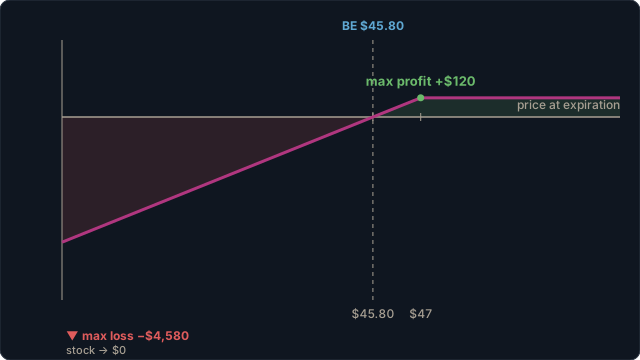
Stage 1 max loss (stock to $0): ($47.00 − $1.20) × 100 = $45.80 × 100 = $4,580
Stage 1 breakeven: $47.00 − $1.20 = $45.80 per share (matches the effective cost basis if assigned)
Stage 1 outcome at three expiration prices
| XYZ at Stage 1 expiry | Put P&L | Note |
|---|---|---|
| $50 | +$120 | Above strike; put expires worthless, full premium kept, wheel restarts at Stage 1 |
| $45.80 | $0 | Breakeven; if assigned here, effective basis equals market price |
| $40 | −$580 | Deep ITM; put assigned at $47, effective basis $45.80 vs. $40 market = $580 unrealized loss on the shares entering Stage 2 |
Stage 1 outcome: put assigned (XYZ closes at $45 at expiry)
Put intrinsic at $45: $47 − $45 = $2 > $0 → put is in the money; the OCC assigns the writer.
Shares acquired at: $47 per share (strike price, per assignment terms)
Effective cost basis: $47.00 − $1.20 = $45.80 per share
Stage 1 P&L at assignment: Stock is acquired at $47 (above market at $45), immediately marked down $2 × 100 = $200. Premium collected offsets partially: $120. Mark-to-market loss at acquisition = −$200 + $120 = −$80. This is not a realized loss — it reflects that the shares were bought above market.
Stage 2 setup: covered call
| Parameter | Value |
|---|---|
| Shares held | 100 shares of XYZ, effective basis $45.80 |
| Stage 2 call strike | $48 (above effective basis of $45.80) |
| Stage 2 call premium received | $1.00 per share ($100 total) |
| Days to expiration (Stage 2) | 30 |
CC max profit: ($1.00 + $48 − $45.80) × 100 = $3.20 × 100 = $320
CC breakeven: $45.80 − $1.00 = $44.80 per share
Stage 2 outcome: call assigned (XYZ closes at $50 at expiry)
Call intrinsic at $50: $50 − $48 = $2 > $0 → call is in the money; the OCC assigns the writer.
Shares sold at: $48 per share (strike price, per assignment terms)
Full-cycle P&L (both stages combined)
| Item | Calculation | Amount |
|---|---|---|
| Stage 1 put premium collected | $1.20 × 100 | +$120 |
| Stage 2 call premium collected | $1.00 × 100 | +$100 |
| Stock acquired at (assignment) | $47 × 100 | −$4,700 |
| Stock sold at (call assignment) | $48 × 100 | +$4,800 |
| Full-cycle net P&L | $120 + $100 + ($4,800 − $4,700) | +$320 |
The $320 net profit equals the covered call's max profit formula: ($1.00 + $48 − $45.80) × 100 = $320. The put premium from Stage 1 is already embedded in the $45.80 effective basis, so the two-stage cycle nets the same as the covered call formula built on that basis.
After call assignment, the $4,700 cash collateral is returned plus $120 premium from Stage 1 and $100 from Stage 2 and the $100 capital gain on the shares. The trader now holds cash and can sell a new put to restart the wheel.
What Can Go Wrong
The primary risk of the wheel strategy is a substantial, sustained stock decline after assignment.
- Stock falls sharply after assignment: If XYZ falls from $47 (assignment price) to $30, the mark-to-market loss is ($47 − $30) × 100 = $1,700. The premiums collected ($120 + any covered call premiums) partially offset this, but cannot fully recover a large decline in a few 30-day cycles. The trader is then holding shares with a large unrealized loss.
- Covered call caps upside: In Stage 2, if the stock rallies strongly above the call strike, the shares are called away at the lower strike. The trader misses the additional gain. The wheel does not participate in sharp stock rallies above the covered call strike.
- Assignment on the short put does not guarantee a profit: Assignment is a stock acquisition at the put strike price, not a profit event. The premium received reduces the basis but does not guarantee that subsequent covered calls will fully recover any unrealized loss on the shares.
The wheel strategy is most appropriate when the trader is willing to hold the underlying stock at the assigned price for an extended period if necessary — not as a purely mechanical premium-collection system independent of the stock's fundamentals.
Margin and Capital Requirement
Stage 1 (cash-secured put) requires cash collateral equal to the put strike times 100. Stage 2 (covered call) is fully collateralized by the long shares. No margin borrowing is required for the standard wheel as described. A cash-secured put occupies the full cash collateral until expiration or assignment; the capital is released when the position closes or is transitioned to Stage 2.
Model the CSP or covered call stages in the P&L calculator.
Options Profit CalculatorMore Strategy Guides
- Cash-Secured Put — Stage 1 of the wheel (short put + cash collateral)
- Covered Call — Stage 2 of the wheel (long stock + short call)
- Protective Put — long stock + long put, downside hedge
- Bull Put Spread — defined-risk version of the short put
- Bear Call Spread — short lower-strike call + long higher-strike call
- Iron Condor — short OTM put spread + short OTM call spread
- Iron Butterfly — short ATM straddle + long OTM wings
- Calendar Spread — short near-dated + long far-dated, same strike
Frequently Asked Questions
- What is the wheel strategy?
- The wheel strategy is a multi-stage options approach: (1) sell a cash-secured put on a stock you are willing to own; (2) if assigned, acquire the shares at the put strike as the effective cost basis; (3) sell covered calls on those shares until they are called away; then repeat. Each stage uses a single defined-risk options position — a cash-secured put or a covered call.
- What is the effective cost basis after CSP assignment in the wheel?
- After a cash-secured put is assigned, the effective cost basis per share equals the put strike minus the put premium received. Example: sell $47 put for $1.20 and get assigned — effective cost basis = $47.00 minus $1.20 = $45.80 per share. This is the starting point for the covered call stage.
- What are the risks of the wheel strategy?
- The primary risk is owning shares of a stock that declines substantially after assignment. The put premium and covered call premiums provide a partial offset, but they do not eliminate stock-price risk. If the stock falls from $50 to $30 after the put is assigned at $47, the position shows a large mark-to-market loss that premiums collected cannot fully recover in the short term. The wheel works best on stocks the trader is fundamentally comfortable owning long-term.
- How does the wheel strategy relate to covered calls and cash-secured puts?
- The wheel strategy is a sequenced combination of a cash-secured put (Stage 1) and a covered call (Stage 2). Each stage uses the exact same formulas described in the standalone guides for those strategies. The wheel adds the transition mechanic: assignment on the put delivers shares that become the collateral for the covered call. The strategies are not modified — they are chained.
- Can the wheel strategy be run indefinitely?
- Mechanically, yes — after the covered call is assigned, the trader returns to selling a new cash-secured put and the cycle restarts. In practice, the cycle ends if: (a) the trader closes the position voluntarily, (b) the stock moves so far against the position that the trader exits to limit losses, or (c) the trader decides not to sell a new put after call assignment. Each stage is a discrete trade that can be closed independently.
Sources
- OCC — Characteristics and Risks of Standardized Options (assignment mechanics for puts and calls)
- Cboe — Options Education Center
- FINRA — Options Investing Overview