Bear Call Spread: Formula, Max Loss and Worked Example
A bear call spread is a credit spread constructed by selling a call at a lower strike and simultaneously buying a call at a higher strike on the same underlying and expiration; the trade collects a net credit because the short call is worth more than the long call. Maximum profit equals the net credit received, and maximum loss equals the strike width minus the net credit — both are defined at entry.
Construction
A bear call spread has two legs on the same underlying and the same expiration cycle.
| Leg | Position | Strike | Role |
|---|---|---|---|
| Short call | Sell 1 call | Lower strike (K1) | Generates premium income; the position profits when this call expires worthless |
| Long call | Buy 1 call | Higher strike (K2) | Caps the loss if the underlying rallies above K1; defines the maximum loss |
Because the lower-strike call is worth more than the higher-strike call for the same expiration, the trade collects a net credit at entry. Both calls must be out of the money (both strikes above the current underlying price) for the classic bear call spread. The spread width is K2 − K1.
Payoff Formulas at Expiration
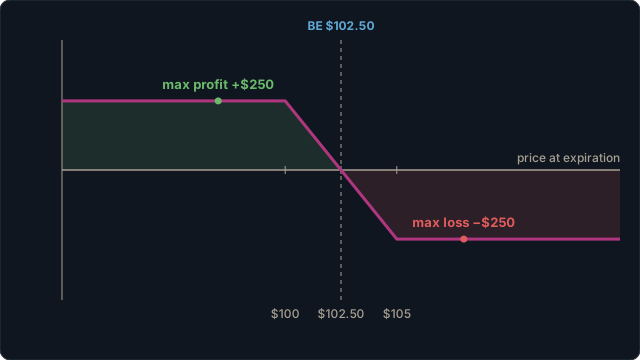
Max profit is realized when the underlying closes at or below K1 at expiration. Max loss is realized when the underlying closes at or above K2. Between K1 and K2, the P&L scales linearly from max profit at K1 to max loss at K2.
Worked Example
All inputs are stated explicitly. Arithmetic is shown so every figure can be verified.
| Input | Value |
|---|---|
| Underlying (XYZ) | $98 per share at entry |
| Short call strike (K1) | $100 |
| Long call strike (K2) | $105 |
| Spread width | $5 |
| Short call premium received | $4.00 per share |
| Long call premium paid | $1.50 per share |
| Net credit | $4.00 − $1.50 = $2.50 per share |
| Contracts | 1 |
| Capital required | ($5.00 − $2.50) × 100 = $250 (margin requirement — equals max loss) |
Max profit: $2.50 × 100 = $250 (both calls expire worthless)
Max loss: ($5.00 − $2.50) × 100 = $250
Breakeven: $100 + $2.50 = $102.50
Payoff at five expiration prices
| XYZ at expiry | Short $100 call P&L | Long $105 call P&L | Net P&L | Note |
|---|---|---|---|---|
| $90 | +$400 (expires worthless) | −$150 (expires worthless) | +$250 | Max profit |
| $100 | +$400 | −$150 | +$250 | Max profit (stock at K1) |
| $102.50 | $4−$2.50=$1.50×100=+$150 | −$150 | $0 | Breakeven |
| $105 | $4−$5=−$1×100=−$100 | −$150 | −$250 | Max loss |
| $115 | $4−$15=−$11×100=−$1,100 | $10−$1.50=$8.50×100=+$850 | −$250 | Max loss (capped by long call) |
At $115, without the long $105 call the short $100 call would produce an unbounded loss of −$1,100. The long call gains $850, netting a −$250 loss — the same max loss as at $105. The long call is what transforms an uncovered call write into a defined-risk spread.
Assignment and Expiration Mechanics
Both legs are American-style equity calls, meaning either can be exercised by the holder at any time. Assignment risk on the short leg is real:
- Both OTM at expiry (XYZ ≤ $100): Both expire worthless; the trader keeps the full $250 credit.
- Short ITM, long OTM at expiry ($100 < XYZ < $105): The short $100 call is assigned; the trader must sell 100 shares at $100. The long $105 call expires worthless. The trader either buys shares at market to deliver, or already holds them. P&L scales between $0 and −$250.
- Both ITM at expiry (XYZ ≥ $105): Both calls are assigned/exercised. The short leg obligates delivery at $100; the long leg can be exercised to buy at $105. The net is a $500 loss on the strike differential minus the $250 credit received = −$250 max loss.
Early assignment risk. If the underlying rallies sharply, the short call may be exercised early (American-style). The position is never naked — the long $105 call remains in place and continues to cap the maximum loss at the defined-risk amount — but early assignment converts the short option into a short stock position (short 100 shares delivered at $100), which the trader resolves by buying shares at market, exercising the long call, or selling the long call and covering. A separate consideration is pin risk: when the underlying closes at or very near the short strike at expiration, the trader cannot know until after the close whether the short call will be assigned, leaving an uncertain share position going into the next session. Brokers typically manage in-the-money spreads automatically, but traders should monitor spreads near expiration.
Margin and Capital Requirement
A bear call spread is a defined-risk position. The maximum loss is the strike width minus the credit received — in this example, $250. Brokers typically require a margin hold equal to the maximum loss: ($500 width − $250 credit = $250 required). No additional buying power is consumed beyond this hold because the long call fully caps the short call's potential loss.
Bear Call Spread vs. Bull Put Spread
A bear call spread and a bull put spread are mirror-image credit spreads. Both have the same risk-reward structure — max profit equals the net credit, max loss equals the spread width minus the credit. The difference is in direction and option type.
| Feature | Bear Call Spread | Bull Put Spread |
|---|---|---|
| Option type | Calls | Puts |
| Position bias | Neutral-to-bearish | Neutral-to-bullish |
| Profitable when | Underlying stays below short call strike | Underlying stays above short put strike |
| Max profit | Net credit received | Net credit received |
| Max loss | Width − credit | Width − credit |
Model this spread's P&L or drill its flashcards.
Options Profit CalculatorMore Strategy Guides
- Bull Put Spread — mirror-image credit spread using puts
- Covered Call — long stock + short OTM call, income overlay
- Protective Put — long stock + long put, downside hedge
- Cash-Secured Put — short put + full cash collateral
- Iron Condor — short OTM put spread + short OTM call spread
- Iron Butterfly — short ATM straddle + long OTM wings
- Calendar Spread — short near-dated + long far-dated, same strike
- Wheel Strategy — CSP to assignment to covered call cycle
Frequently Asked Questions
- What is a bear call spread?
- A bear call spread is a two-leg credit spread: sell (short) a call at a lower strike and simultaneously buy (long) a call at a higher strike on the same underlying and expiration. The short call premium exceeds the long call premium, so the trade collects a net credit. The position profits when the underlying stays below the short strike at expiration.
- What is the maximum profit on a bear call spread?
- Maximum profit equals the net credit received times 100 times contracts. Example: sell $100 call for $4, buy $105 call for $1.50 — net credit = $2.50; max profit = $2.50 times 100 = $250. This is achieved when both calls expire worthless, which happens when the underlying closes at or below the short call strike at expiration.
- What is the maximum loss on a bear call spread?
- Maximum loss equals (strike width minus net credit) times 100 times contracts. Example: $5 wide spread (strikes $100 and $105), net credit $2.50 — max loss = ($5 minus $2.50) times 100 = $250. This occurs when the underlying closes at or above the long call strike at expiration and both legs are fully in the money.
- What is the bear call spread breakeven?
- Breakeven equals the short call strike plus the net credit received. Example: short strike $100, net credit $2.50 — breakeven = $100 plus $2.50 = $102.50. At $102.50 the loss on the short call exactly offsets the credit collected, and the spread has zero net P&L at expiration.
- How is a bear call spread different from a bull put spread?
- Both are credit spreads with identical risk-reward math (max profit = net credit, max loss = width minus credit). The difference is in the option type used. A bear call spread uses calls and profits when the underlying stays below the short call strike. A bull put spread uses puts and profits when the underlying stays above the short put strike. Directional bias is the same (neutral-to-bearish for bear call; neutral-to-bullish for bull put), but the strikes and Greeks differ.
Sources
- OCC — Characteristics and Risks of Standardized Options (spread assignment and pin risk)
- Cboe — Options Education Center
- FINRA — Options Investing Overview