Iron Butterfly Options Strategy: Construction, Payoff and Worked Example
An iron butterfly is a four-leg options strategy that combines a short at-the-money straddle (short ATM call + short ATM put) with long out-of-the-money wings that cap the maximum loss. Maximum profit equals the net credit collected at entry; maximum loss equals the wing width minus the net credit.
Construction
All four legs share the same underlying and the same expiration date. The two short options are at the same strike (the “body”); the two long options are equidistant from it (the “wings”).
| Leg | Action | Strike | Role |
|---|---|---|---|
| Short call | Sell 1 ATM call | Center (e.g. $100) | Collects premium; body of butterfly |
| Short put | Sell 1 ATM put | Center (e.g. $100) | Collects premium; body of butterfly |
| Long call | Buy 1 OTM call | Above center (e.g. $105) | Caps upside loss; upper wing |
| Long put | Buy 1 OTM put | Below center (e.g. $95) | Caps downside loss; lower wing |
The net position is entered for a credit. Traders use an iron butterfly when they expect the underlying to remain near the short strike through expiration — high implied volatility (expensive options) makes the position more attractive because the credit collected is larger relative to the wings’ cost.
Payoff Formulas at Expiration
Wing width is the distance from the short strike to either outer strike. The wings are typically symmetric (equal width on both sides), but asymmetric configurations are possible. If the wings are unequal, the maximum loss is determined by the wider side: wider wing width − net credit. For example, with the short straddle at $100, a long put at $95 (5-wide) and a long call at $107 (7-wide) for a $3.70 net credit, a close at or below $95 loses $5.00 − $3.70 = $1.30 per share, while a close at or above $107 loses $7.00 − $3.70 = $3.30 per share — the wider call side sets the $330 maximum loss.
Worked Example
| Input | Value |
|---|---|
| Underlying (XYZ) | $100.00 |
| Short call strike | $100 (ATM) — sold for $3.00 |
| Short put strike | $100 (ATM) — sold for $2.50 |
| Long call strike | $105 (OTM) — bought for $1.00 |
| Long put strike | $95 (OTM) — bought for $0.80 |
| Net credit | $3.00 + $2.50 − $1.00 − $0.80 = $3.70 per share ($370 total) |
| Wing width | $5 (from $100 to $105, or $100 to $95) |
| Capital required | ($5.00 − $3.70) × 100 = $130 (margin requirement — equals max loss) |
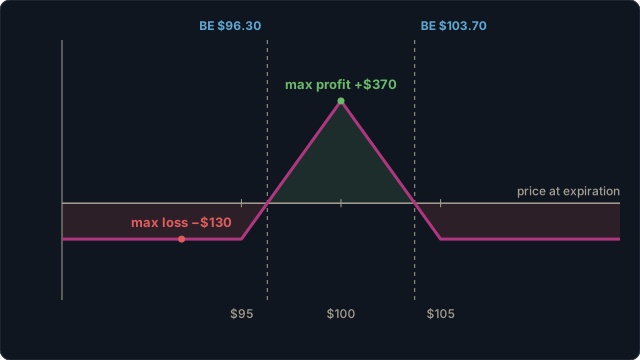
Max profit: $3.70 × 100 = $370 (XYZ at exactly $100 at expiry)
Max loss: ($5.00 − $3.70) × 100 = $1.30 × 100 = $130 (XYZ at or beyond $95 or $105)
Lower breakeven: $100 − $3.70 = $96.30
Upper breakeven: $100 + $3.70 = $103.70
Arithmetic verification at three key prices
At $92 (below lower wing): Short $100 call: +$3.00 (OTM, worthless). Long $105 call: −$1.00 (OTM, worthless). Short $100 put: $100−$92 = $8 ITM → −$8 + $2.50 = −$5.50. Long $95 put: $95−$92 = $3 ITM → +$3 − $0.80 = +$2.20. Total: $3.00 − $1.00 − $5.50 + $2.20 = −$1.30. Max loss confirmed.
At $100 (short strike): Short call and short put each expire at $0 intrinsic value (+$3.00 + $2.50 = +$5.50 total). Long wings expire worthless (−$1.00 − $0.80 = −$1.80). Total: $5.50 − $1.80 = +$3.70. Max profit confirmed.
At $108 (above upper wing): Short $100 call: $108−$100 = $8 ITM → −$8 + $3.00 = −$5.00. Long $105 call: $108−$105 = $3 ITM → +$3 − $1.00 = +$2.00. Short $100 put: +$2.50 (OTM). Long $95 put: −$0.80 (OTM). Total: −$5.00 + $2.00 + $2.50 − $0.80 = −$1.30. Max loss confirmed.
Payoff table
| XYZ at expiry | P&L per share | P&L total (1 set) | Note |
|---|---|---|---|
| $92 | −$1.30 | −$130 | Max loss (below lower wing) |
| $96.30 | $0 | $0 | Lower breakeven |
| $100 | +$3.70 | +$370 | Max profit (at short strike) |
| $103.70 | $0 | $0 | Upper breakeven |
| $108 | −$1.30 | −$130 | Max loss (above upper wing) |
Expiration and Assignment Mechanics
At expiration the OCC will exercise any option with $0.01 or more of intrinsic value. For the iron butterfly:
- XYZ between $96.30 and $103.70: One or both short options may be assigned, but the net P&L is positive. The long wings expire worthless.
- XYZ at exactly $100: Both the short call and short put are at-the-money with zero intrinsic value; they typically expire worthless. Maximum profit.
- XYZ at or beyond $95 or $105: The relevant short option is deep ITM and fully assigned; the long wing offsets the loss beyond the outer strike. Maximum loss realized.
Pin risk arises when XYZ closes exactly at the short strike on expiration day. The short call or put may or may not be assigned by the holder, creating an uncertain overnight position. Traders often close the position before expiration to avoid pin risk. (Source: OCC)
Margin and Capital Requirement
An iron butterfly is a defined-risk spread. Brokers typically require margin equal to the maximum loss per set: wing width minus net credit, times 100. In the example: ($5 − $3.70) × 100 = $130. This is the net debit at worst-case expiration. Because the long wings define the maximum loss, no additional buying power beyond the margin requirement is at risk.
Iron Butterfly vs. Iron Condor
| Feature | Iron Butterfly | Iron Condor |
|---|---|---|
| Short strikes | Both at the same ATM strike | Two separate OTM strikes (put side and call side) |
| Net credit | Higher (ATM options are more expensive) | Lower (OTM options are cheaper) |
| Profitable range | Narrower (short strike ± net credit) | Wider (gap between short strikes ± credit) |
| Payoff shape | Tent peak at short strike | Flat plateau between short strikes |
| Ideal market outlook | Underlying stays near ATM strike | Underlying stays in a broad range |
Drill iron butterfly flashcards or model this position in the P&L calculator.
Options Profit CalculatorMore Strategy Guides
- Iron Condor — wider wings, lower credit, wider profit zone
- Calendar Spread — time-based vega play at a single strike
- Covered Call — long stock + short OTM call
- Cash-Secured Put — short put + full cash collateral
- Protective Put — long stock + long put, downside hedge
- Bull Put Spread — short higher-strike put + long lower-strike put
- Bear Call Spread — short lower-strike call + long higher-strike call
- Wheel Strategy — CSP to assignment to covered call cycle
Frequently Asked Questions
- What is an iron butterfly?
- An iron butterfly is a four-leg options strategy: short 1 at-the-money call, short 1 at-the-money put (together: a short ATM straddle), long 1 out-of-the-money call, and long 1 out-of-the-money put (the wings). All four options share the same expiration. The short strike is the center of the structure.
- What is the maximum profit on an iron butterfly?
- Maximum profit equals the net credit received when entering the trade. It is achieved when the underlying closes exactly at the short strike at expiration — both the short call and the short put expire at zero intrinsic value, and the long wings also expire worthless.
- What is the maximum loss on an iron butterfly?
- Maximum loss equals the wing width minus the net credit. Wing width is the distance from the short strike to either outer (long) strike. Example: short strike $100, long strikes $95 and $105, net credit $3.70 — max loss = $5.00 − $3.70 = $1.30 per share = $130 total.
- What are the two breakevens of an iron butterfly?
- Lower breakeven = short strike minus net credit. Upper breakeven = short strike plus net credit. Example: short strike $100, net credit $3.70 — lower breakeven = $96.30, upper breakeven = $103.70. The position is profitable between the two breakeven prices at expiration.
- How does an iron butterfly differ from an iron condor?
- An iron butterfly sells the at-the-money straddle and adds OTM wings; an iron condor sells two out-of-the-money spreads with a gap between the short strikes. The butterfly collects a higher net credit and has a narrower profitable range; the condor collects less credit but has a wider range between its breakevens.
Sources
- OCC — Characteristics and Risks of Standardized Options (pin risk, assignment mechanics)
- Cboe — Options Education
- FINRA — Options Investing Overview