Protective Put: Max Loss, Formula and Worked Example
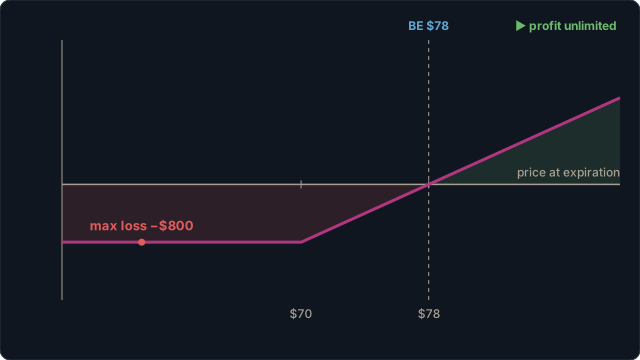
A protective put is an options strategy in which a trader holds 100 shares of a stock and simultaneously buys one put option on those same shares; the long put acts as downside insurance, capping the loss if the stock falls. Maximum loss is defined and equals (cost basis − put strike + premium paid) × 100 regardless of how far the stock declines; maximum profit is unlimited as the stock rises above the breakeven price.
Construction
A protective put has exactly two components on the same underlying and the same expiration cycle.
| Leg | Position | Quantity | Role |
|---|---|---|---|
| Long stock | Buy (or already own) shares | 100 shares per contract | Captures upside; suffers loss if stock falls |
| Long put | Buy 1 OTM put | 1 contract = 100 shares | Provides a floor — gains intrinsic value as stock falls below strike |
The put strike is typically 5–15% below the current share price (out of the money). A higher-strike put (closer to the money) costs more premium but provides a tighter floor. A lower-strike put costs less but allows a larger loss before protection kicks in.
Payoff Formulas at Expiration
The max loss formula holds for any stock price at or below the put strike. Below the strike, every dollar of stock loss is offset by a dollar of put gain, so the total loss is frozen at the formula value. Above the put strike, the put expires worthless and the loss on the shares continues to narrow as the stock rises toward the breakeven.
Worked Example
All inputs are stated explicitly. Arithmetic is shown so every figure can be verified.
| Input | Value |
|---|---|
| Shares purchased | 100 shares of XYZ |
| Share cost basis | $75.00 per share ($7,500 total) |
| Put strike purchased | $70 (OTM by $5) |
| Days to expiration | 30 |
| Put premium paid | $3.00 per share ($300 total) |
| Capital required | $7,500 (shares) + $300 (put) = $7,800 |
Max loss: ($75.00 − $70 + $3.00) × 100 = $8.00 × 100 = $800
Breakeven: $75.00 + $3.00 = $78.00 per share
Max profit: Unlimited — each dollar above $78 yields $100 in total profit.
Payoff at five expiration prices
| XYZ at expiry | Stock P&L | Put P&L | Net P&L | Note |
|---|---|---|---|---|
| $55 | −$2,000 | ($70−$55−$3)×100 = +$1,200 | −$800 | Floor at max loss |
| $70 | −$500 | ($70−$70−$3)×100 = −$300 | −$800 | Floor at max loss (put ATM) |
| $75 | $0 | $0 − $300 = −$300 | −$300 | Stock flat; only put cost |
| $78 | +$300 | −$300 | $0 | Breakeven |
| $90 | +$1,500 | −$300 | +$1,200 | Uncapped upside |
At $55, the put provides ($70 − $55) × 100 = $1,500 in intrinsic value, less the $300 premium = $1,200 gain on the put. The stock loss at $55 is ($75 − $55) × 100 = $2,000. Net: $1,200 − $2,000 = −$800 — identical to the result at $70 or any price below the put strike.
Assignment and Expiration Mechanics
A protective put holder has the right, but not the obligation, to exercise the put. At expiration, the OCC automatically exercises puts with $0.01 or more of intrinsic value.
- Stock above put strike at expiry (XYZ > $70): The put expires worthless. The trader retains the shares and has lost the $300 put premium. The position continues as a naked long-stock holding after expiry.
- Stock below put strike at expiry (XYZ < $70): The put is in the money and will be automatically exercised. The trader sells 100 shares at the put strike ($70), closing the stock position. Net proceeds = $70 × 100 − $300 premium = $6,700 recovered on a position with a $7,500 cost basis, for a $800 loss — the floored max loss.
- Rolling: Before expiration, traders often roll the put forward by selling the expiring put and buying a new put with a later expiration. The cost of rolling consumes additional premium.
Margin and Capital Requirement
A protective put is a long-stock position with a purchased put. It requires full payment for the shares plus the put premium — no margin benefit is provided. Brokers typically classify it as a Level 1 or Level 2 options strategy because the maximum loss is defined. The total capital deployed in the worked example is $7,500 (shares) + $300 (put) = $7,800.
Protective Put vs. Covered Call
| Feature | Protective Put | Covered Call |
|---|---|---|
| Stock held | Yes, long 100 shares | Yes, long 100 shares |
| Options leg | Buy a put (costs premium) | Sell a call (receives premium) |
| Effect on cost basis | Raises breakeven by premium paid | Lowers breakeven by premium received |
| Downside | Capped at max loss formula | Uncapped (offset only by premium received) |
| Upside | Unlimited above breakeven | Capped at short call strike |
| Income vs. protection | Cost (pure insurance) | Income (premium collection) |
Model the protective put P&L or drill this strategy's flashcards.
Options Profit CalculatorMore Strategy Guides
- Covered Call — long stock + short OTM call, neutral-bullish income overlay
- Cash-Secured Put — short put + full cash collateral
- Bull Put Spread — short higher-strike put + long lower-strike put
- Bear Call Spread — short lower-strike call + long higher-strike call
- Iron Condor — short OTM put spread + short OTM call spread
- Iron Butterfly — short ATM straddle + long OTM wings
- Calendar Spread — short near-dated + long far-dated, same strike
- Wheel Strategy — CSP to assignment to covered call cycle
Frequently Asked Questions
- What is a protective put?
- A protective put is a two-leg strategy: long 100 shares of a stock plus long 1 put option on the same underlying, with a strike below the current share price. The long put acts as insurance — if the stock falls below the put strike, the put gains intrinsic value that offsets the loss on the shares, capping the total downside.
- What is the maximum loss on a protective put?
- Maximum loss equals (cost basis minus put strike plus premium paid) times 100. Example: buy stock at $75, buy $70 put for $3 — max loss = ($75 minus $70 plus $3) times 100 = $800. This loss is the same whether the stock falls to $70 or to zero, because the put provides a floor at the strike.
- What is the protective put breakeven?
- Breakeven equals cost basis plus the put premium paid. Example: buy stock at $75, buy put for $3 — breakeven = $75 plus $3 = $78. The stock must rise above $78 at expiration for the position to be profitable, because the premium paid on the put raises the effective cost of the shares.
- How does a protective put compare to a covered call?
- Both strategies hold long stock, but they serve opposite purposes. A covered call sells a call to collect premium income, which slightly reduces the cost basis but caps upside. A protective put buys a put to cap downside, which increases the cost basis but preserves unlimited upside. A covered call pays you; a protective put costs you — each is appropriate in different risk environments.
- What is the maximum profit on a protective put?
- Maximum profit is theoretically unlimited because the long stock position has no upside cap. Above the breakeven price (cost basis plus premium), the position profits dollar-for-dollar as the stock rises. The put premium paid reduces the effective profit versus holding stock outright.
Sources
- OCC — Characteristics and Risks of Standardized Options (long option exercise and expiration mechanics)
- Cboe — Options Strategies Education
- FINRA — Options Investing Overview