Bull Put Spread: Setup, Payoff and Worked Example
A bull put spread is a two-leg, defined-risk options strategy: sell 1 put at a higher strike and buy 1 put at a lower strike, both with the same expiration, for a net credit. Maximum profit equals the net credit; maximum loss equals the strike width minus the net credit — capped by the long put at the lower strike.
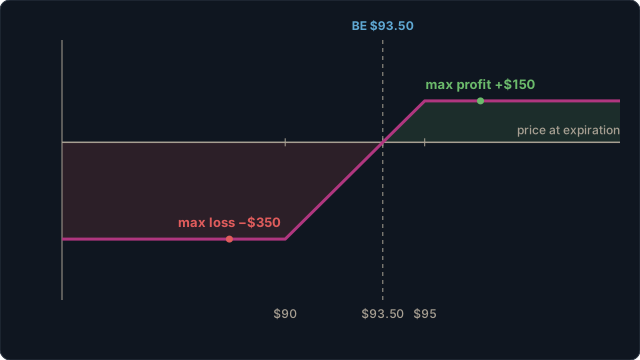
Construction
Both legs are puts on the same underlying with the same expiration. The spread is entered for a net credit because the short put (higher strike, closer to ATM) is worth more than the long put (lower strike, further OTM).
| Leg | Action | Strike | Role |
|---|---|---|---|
| Short put | Sell 1 put | Higher strike (closer to ATM) | Generates credit; obligates purchase at this strike if assigned |
| Long put | Buy 1 put | Lower strike (further OTM) | Caps maximum loss; defines the lower boundary of risk |
The strategy has a bullish-to-neutral outlook. It profits when the underlying stays flat or rises through expiration. Implied volatility affects both legs’ premiums; higher IV produces a larger net credit for the same strikes.
Payoff Formulas at Expiration
Strike width = short put strike − long put strike. The breakeven is the short put strike minus the credit: below this point the premium no longer fully offsets the assignment loss. At or above the short strike at expiration, both puts are OTM and the full credit is kept.
Worked Example
| Input | Value |
|---|---|
| Underlying (XYZ) | $100.00 |
| Short put strike | $95 — sold for $2.50 |
| Long put strike | $90 — bought for $1.00 |
| Net credit | $2.50 − $1.00 = $1.50 per share ($150 total) |
| Strike width | $95 − $90 = $5 |
| Capital required | ($5.00 − $1.50) × 100 = $350 (margin requirement — equals max loss) |
Max profit: $1.50 × 100 = $150 (XYZ at or above $95 at expiry)
Max loss: ($5.00 − $1.50) × 100 = $3.50 × 100 = $350 (XYZ at or below $90)
Breakeven: $95.00 − $1.50 = $93.50 per share
Arithmetic verification at key prices
At $85 (below long put strike): Short $95 put: $95−$85 = $10 ITM → −$10 + $2.50 = −$7.50. Long $90 put: $90−$85 = $5 ITM → +$5 − $1.00 = +$4.00. Total: −$7.50 + $4.00 = −$3.50 per share = −$350. Max loss confirmed.
At $90 (at long put strike): Short $95 put: $95−$90 = $5 ITM → −$5 + $2.50 = −$2.50. Long $90 put: exactly ATM, zero intrinsic → −$1.00 (full premium lost). Total: −$2.50 − $1.00 = −$3.50. Still max loss — the long put at exactly $90 has zero intrinsic value.
At $93.50 (breakeven): Short $95 put: $95−$93.50 = $1.50 ITM → −$1.50 + $2.50 = +$1.00. Long $90 put: OTM (>$90), expires worthless → −$1.00. Total: +$1.00 − $1.00 = $0. Breakeven confirmed.
At $95 (short put strike): Short $95 put: expires at $0 intrinsic (ATM), P&L = +$2.50. Long $90 put: OTM → −$1.00. Total: +$2.50 − $1.00 = +$1.50. Max profit confirmed.
At $102 (above both strikes): Both puts OTM and worthless. Short put: +$2.50. Long put: −$1.00. Total: +$1.50. Max profit confirmed.
Payoff table
| XYZ at expiry | P&L per share | P&L total | Note |
|---|---|---|---|
| $82 | −$3.50 | −$350 | Max loss (below long put strike) |
| $90 | −$3.50 | −$350 | Max loss (at long put strike) |
| $93.50 | $0 | $0 | Breakeven |
| $95 | +$1.50 | +$150 | Max profit (at or above short put strike) |
| $102 | +$1.50 | +$150 | Max profit |
Assignment and Expiration Mechanics
The short $95 put is the only leg that can result in assignment.
- XYZ at or above $95 at expiration: Both puts expire worthless. Full credit kept. No assignment.
- XYZ between $90 and $95: Short $95 put is assigned (buy 100 shares at $95); long $90 put expires worthless. Net P&L slides from $0 to −$350 as XYZ falls from the breakeven toward $90.
- XYZ at or below $90: Short $95 put is assigned (buy at $95); long $90 put is exercised or sold (worth $5 per share). The two offsets cancel beyond $90 — max loss is flat below $90.
When the short put is assigned at $95, the trader acquires 100 shares with an effective cost basis of $95 − $1.50 = $93.50 (the breakeven). If the stock is at or below $90, selling the long $90 put for its intrinsic value ($90 − stock price) lowers that basis further, to $93.50 − ($90 − stock price) = stock price + $3.50 — the shares are held at exactly $3.50 per share above the market, the worst-case $350 spread loss, no matter how far the stock has fallen. If shares are assigned with the stock exactly at $90, that all-in basis equals $90 + $3.50 = $93.50.
Early assignment on the short put is uncommon — put holders rarely exercise early because they give up remaining time value. (Source: OCC)
Margin and Capital Requirement
A bull put spread is a defined-risk strategy. Margin requirement is typically the maximum loss: (strike width − net credit) × 100. For the example: ($5 − $1.50) × 100 = $350 per spread. The long put at $90 is the hedge that limits the broker’s exposure to this fixed amount. No buying power beyond $350 per spread is consumed.
Compare this to a cash-secured put at the same short strike ($95): that strategy would require $95 × 100 = $9,500 in cash collateral for potentially the same short put. The bull put spread dramatically reduces the capital requirement by adding the long put as protection.
Bull Put Spread vs. Cash-Secured Put
| Feature | Bull Put Spread | Cash-Secured Put |
|---|---|---|
| Legs | Short put + long put (spread) | Short put only |
| Max loss | Strike width − net credit (defined) | Strike − premium (large; theoretically down to zero) |
| Net credit | Less (long put costs premium) | More (no long put deduction) |
| Margin / collateral | Max loss only (e.g., $350) | Full strike × 100 (e.g., $9,500) |
| Capital efficiency | Higher | Lower |
| Assignment outcome | Shares acquired; long put offsets below its strike | Shares acquired at strike; no offset |
Drill bull put spread flashcards or model this position in the P&L calculator.
Options Profit CalculatorMore Strategy Guides
- Bear Call Spread — mirror-image credit spread using calls instead of puts
- Iron Condor — combines a bull put spread + bear call spread
- Cash-Secured Put — undefined-risk version of the short put leg
- Covered Call — long stock + short OTM call
- Protective Put — long stock + long put, downside hedge
- Iron Butterfly — short ATM straddle + long OTM wings
- Calendar Spread — short near-dated + long far-dated, same strike
- Wheel Strategy — CSP to assignment to covered call cycle
Frequently Asked Questions
- What is a bull put spread?
- A bull put spread (also called a short put spread or credit put spread) is a two-leg options strategy: short 1 put at a higher strike and long 1 put at a lower strike, both with the same expiration. It is entered for a net credit. The strategy profits when the underlying stays above the short strike at expiration.
- What is the maximum profit on a bull put spread?
- Maximum profit equals the net credit received. It is realized when the underlying closes at or above the short put strike at expiration — both puts expire worthless and the full credit is kept.
- What is the maximum loss on a bull put spread?
- Maximum loss equals the strike width minus the net credit, multiplied by 100. Example: short $95 put, long $90 put, net credit $1.50 — max loss = ($5.00 − $1.50) × 100 = $350. The long put caps the loss and defines the risk — no assignment on the short put can lose more than this amount.
- What is the breakeven for a bull put spread?
- Breakeven equals the short put strike minus the net credit. Example: short $95 put, net credit $1.50 — breakeven = $95.00 − $1.50 = $93.50. Below $93.50, the position loses money at expiration.
- How does a bull put spread differ from a cash-secured put?
- A cash-secured put is undefined-risk below the breakeven (bounded only by the stock going to zero), while a bull put spread adds a long put that caps the maximum loss at the strike width minus the net credit. The spread collects less premium than a naked put at the same short strike, but reduces margin requirement and defines the maximum risk.
Sources
- OCC — Characteristics and Risks of Standardized Options (put assignment and spread mechanics)
- Cboe — Options Education
- FINRA — Options Investing Overview