Calendar Spread: Setup, Cost and Worked Example
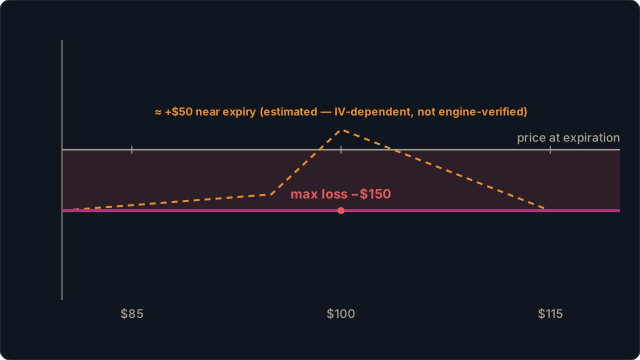
A calendar spread (also called a time spread or horizontal spread) is a two-leg options strategy that sells a near-dated option and simultaneously buys a far-dated option at the same strike on the same underlying; the net debit paid at entry is the maximum loss. There is no closed-form maximum profit formula at near-leg expiry — profit depends on how much time value the long option retains when the short option expires, which in turn depends on implied volatility at that moment.
Construction
A calendar spread has two legs on the same underlying and same strike, but different expiration cycles.
| Leg | Position | Expiration | Role |
|---|---|---|---|
| Short option | Sell 1 option (call or put) | Near-dated (shorter) | Decays faster; premium received |
| Long option | Buy 1 option (same type) | Far-dated (longer) | Decays more slowly; premium paid; also covers the short leg obligation |
The far-dated option is always worth more than the near-dated option at the same strike, so the spread costs a net debit. Both legs are typically at or near the money. The most common version uses calls; a put calendar spread has the same mechanics and is used when put options have better bid-ask spreads or skew is favorable.
The long leg fully covers the short leg. If the short call is exercised early (American-style equity options), the long call can be exercised simultaneously to deliver shares — no unbounded risk. This is what makes the calendar spread a defined-risk trade: the debit paid is the maximum that can be lost.
Maximum Loss — the Net Debit
This is realized when the underlying moves so far from the strike that both options lose nearly all their time value by the time the near leg expires. If the stock is far OTM or far ITM at near expiry, the near-dated option expires nearly worthless (good) but the far-dated option has also lost most of its time value (bad) — the position shows a loss close to the full debit paid.
Why No Exact Maximum Profit Formula Exists
Here is the logic step by step:
- At near expiry, the short option's value is its intrinsic value only (time has run out).
- The long option still has remaining days — it retains intrinsic value plus whatever time value IV supports at that moment.
- The spread value at near expiry = long option value − short option intrinsic value.
- Profit = spread value at near expiry − net debit paid at entry.
- The long option's time value component is not known at entry — it depends on future IV.
The qualitative shape is well-defined: the spread reaches its highest value when the underlying is exactly at the strike at near expiry (short expires worthless, long retains the most time value), and the value decreases as the underlying moves away from the strike in either direction.
Worked Example
All inputs are stated explicitly. Arithmetic is shown for what can be computed exactly; estimated values are labeled as such.
| Input | Value |
|---|---|
| Underlying (XYZ) | $100 per share at entry |
| Strike (both legs) | $100 (at the money) |
| Short leg | Sell 30-day $100 call for $2.00 |
| Long leg | Buy 60-day $100 call for $3.50 |
| Net debit | $3.50 − $2.00 = $1.50 per share |
| Total cost | $1.50 × 100 = $150 |
| Contracts | 1 |
| Capital required | $150 (net debit paid in full — no additional margin) |
Max loss (computed exactly): $1.50 × 100 = $150 (the full debit paid)
Max profit at near expiry (estimated, not exact): If XYZ is at $100 when the 30-day leg expires, the short call expires worthless (gains $200 vs. the premium received). The 60-day call now has 30 days left. Its value depends on IV at that point. If IV is unchanged and the 30-day call for a $100 strike on XYZ is still worth approximately $2.00, the long leg is worth roughly $2.00 — the spread is worth $2.00, and the profit is $2.00 − $1.50 = $0.50 per share = approximately $50.
This estimate would change substantially if IV increases (long leg worth more) or decreases (long leg worth less) by the time near expiry arrives. A 20% increase in IV might push the long leg to $2.50, producing a profit of $100. A 20% decline might push it to $1.60, producing a profit of $10. The uncertainty in IV is the key risk of this strategy.
Spread value at four expiration scenarios (near leg expires)
| XYZ at near expiry | Short call value | Long call est. value | Spread value | Net P&L |
|---|---|---|---|---|
| $80 (far OTM) | $0 | ~$0.00 (worthless) | ~$0.00 | ~−$150 (full loss) |
| $95 (slightly OTM) | $0 | ~$0.40 (time value) | ~$0.40 | ~−$110 (most of debit lost) |
| $100 (at strike) | $0 | ~$2.00 (time value) | ~$2.00 | ~+$50 (near max profit) |
| $115 (far ITM) | $15 (intrinsic) | ~$15.00 (negligible time value) | ~$0.00 | ~−$150 (near full loss) |
These estimates assume IV is unchanged at near expiry and that a 30-day ATM call on XYZ at $100 is worth approximately $2.00 — under the Black-Scholes model (zero interest rate) that anchor implies an IV of roughly 17.5%, and the long-leg values above are computed at that IV. Note how quickly the long call's remaining value falls away from the strike: 5 points OTM it retains only ~$0.40, and deep ITM its time value is negligible, so the spread is worth almost nothing at either extreme. The values are illustrative. Actual values will differ.
Managing the Trade at Near Expiry
When the short leg expires, the trader has three choices:
- Close both legs: Sell the long option and close the position entirely. Realized P&L = sale price of long option − $1.50 debit paid.
- Roll the short leg: Sell another near-dated option against the remaining long. This converts the position into a covered call (if assigned on the short) or continues the calendar spread with a new short leg. Rolling produces additional premium that offsets the original debit.
- Hold the long leg: After the short expires, the long option becomes a standalone long call or long put with its remaining days. No additional debit is consumed, but the original $150 is already paid.
Margin and Capital Requirement
A calendar spread is a debit trade — the net debit is paid upfront and no additional margin is required. Brokers classify it as a defined-risk position because the long leg fully covers the short leg. Total capital at risk is the net debit: $150 in this example. The long leg must be purchased before or simultaneously with the short leg sale to be recognized as a covered spread.
Model single-leg option P&L or drill strategy flashcards.
Options Profit CalculatorMore Strategy Guides
- Covered Call — long stock + short OTM call, income overlay
- Protective Put — long stock + long put, downside hedge
- Cash-Secured Put — short put + full cash collateral
- Bull Put Spread — short higher-strike put + long lower-strike put
- Bear Call Spread — short lower-strike call + long higher-strike call
- Iron Condor — short OTM put spread + short OTM call spread
- Iron Butterfly — short ATM straddle + long OTM wings
- Wheel Strategy — CSP to assignment to covered call cycle
Frequently Asked Questions
- What is a calendar spread?
- A calendar spread (also called a time spread or horizontal spread) is a two-leg options position: sell (short) a near-dated option and simultaneously buy (long) a far-dated option at the same strike price on the same underlying. The near-dated option has more theta decay per day, so the position is designed to profit from time passing while the underlying stays near the strike.
- What is the maximum loss on a calendar spread?
- Maximum loss equals the net debit paid at entry, times 100 times contracts. Example: sell 30-day $100 call for $2.00, buy 60-day $100 call for $3.50, net debit = $1.50 per share; max loss = $1.50 times 100 = $150. This maximum occurs if the underlying moves so far from the strike that both options lose nearly all their time value by near expiry.
- What is the maximum profit on a calendar spread?
- There is no exact closed-form maximum profit formula for a calendar spread at near-leg expiry. The profit depends on how much time value the long (far-dated) option retains when the short (near-dated) option expires. Maximum profit is theoretically achieved when the underlying is exactly at the strike at near expiry, because the short option expires worthless and the long option retains the most time value. The exact dollar amount depends on implied volatility, interest rates, and days remaining in the long leg at that moment.
- What is the calendar spread breakeven?
- A calendar spread does not have a single fixed breakeven because its P&L at near expiry depends on the remaining time value of the long leg, which changes with implied volatility. There are typically two approximate breakeven points — one below and one above the strike — but their exact locations cannot be calculated without knowing IV at the time the near leg expires.
- What is the difference between a calendar spread and a diagonal spread?
- A calendar spread uses the same strike for both legs (different expirations). A diagonal spread uses different strikes and different expirations. Both are time spreads that exploit theta decay differences between near-dated and far-dated options. A diagonal spread is more flexible but harder to analyze because the strike differential adds a directional component to the position.
Sources
- OCC — Characteristics and Risks of Standardized Options (spread and time spread mechanics)
- Cboe — Options Education Center (time decay and calendar spread fundamentals)
- FINRA — Options Investing Overview